Free Dinosaur Printable
Pterodactyl Dot-to-Dot Printable
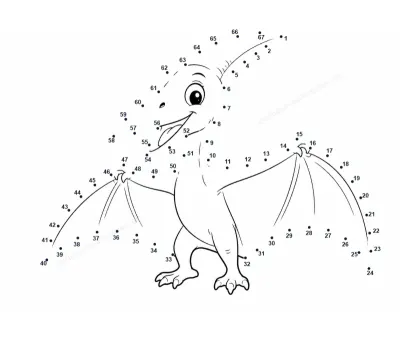
Connect the dots to draw the most famous flying reptile of the prehistoric world! Pterodactyls soared over ancient oceans and rivers hunting for fish. This easy 24-dot worksheet is perfect for toddlers and preschool children.
Difficulty
Medium
!
Fun fact: Pterodactyls were not technically dinosaurs — they were flying reptiles called pterosaurs!
Download Free Printable PDF
Free for home and classroom use.
No sign-up needed. Opens as a PDF. Print on any US Letter (8.5 x 11 inch) paper. Free for home and classroom use.
Back to all dinosaur puzzlesPterodactyl Dot-to-Dot Puzzle Guide
Here is a brilliant puzzle fact to share before you begin: Pterodactyls were not actually dinosaurs at all! They were flying reptiles called pterosaurs, living alongside the dinosaurs but belonging to a completely separate group. They were also the first vertebrates — animals with a backbone — ever to evolve powered flight. With 67 dots this is quite a challenge, so settle in and enjoy the process!
1–10 — The Head and Long Beak
Start at dot 1 and connect through to dot 10 to draw the long, pointed beak and distinctive crested head. The Pterodactyl head is one of the most unusual shapes in the natural world — long, narrow, and often tipped with a dramatic crest. Children practise a very elongated shape here, which is a refreshing challenge.
Fun fact!
Many pterosaur species had large crests on their heads, made of bone and soft tissue. Scientists believe these crests were used for display — attracting mates and communicating with other members of the group. Some crests were as large as the skull itself, making the head almost comically oversized.
Many pterosaur species had large crests on their heads, made of bone and soft tissue. Scientists believe these crests were used for display — attracting mates and communicating with other members of the group. Some crests were as large as the skull itself, making the head almost comically oversized.
11–24 — The Wings
Continue from dot 11 to dot 24 to sweep out the enormous wings. Pterodactyl wings were formed by a membrane of skin and muscle stretching from an enormously elongated fourth finger all the way to the body. Children learn to draw a wide, expansive arc — one of the most satisfying pencil movements in the whole collection.
Fun fact!
The Pterodactyl wing membrane was thin but incredibly tough, reinforced by tiny fibres running through it like a fabric. Unlike bat wings, which attach to the ankle, pterosaur wings attached higher up the leg, giving them a slightly different flight posture — more like a hang-glider than a bird.
The Pterodactyl wing membrane was thin but incredibly tough, reinforced by tiny fibres running through it like a fabric. Unlike bat wings, which attach to the ankle, pterosaur wings attached higher up the leg, giving them a slightly different flight posture — more like a hang-glider than a bird.
25–40 — The Body and Wing Fingers
Trace dots 25 through 40 to fill out the compact body and trace the extraordinary wing-finger structure. This section has the most dots in the puzzle and requires real sustained concentration — a wonderful exercise in perseverance. Remind children that every single dot is progress.
Fun fact!
A Pterodactyl's wingspan could reach around 3 feet — roughly the size of a large seagull — but some of its relatives, like Quetzalcoatlus, had wingspans of up to 36 feet, wider than a small aeroplane. The pterosaur family ranged from sparrow-sized to absolutely staggering.
A Pterodactyl's wingspan could reach around 3 feet — roughly the size of a large seagull — but some of its relatives, like Quetzalcoatlus, had wingspans of up to 36 feet, wider than a small aeroplane. The pterosaur family ranged from sparrow-sized to absolutely staggering.
41–54 — The Claws and Feet
Connect dots 41 to 54 to draw the wing-tip claws and the hind feet. Pterodactyls had claws on their wings for climbing and gripping, which children often find surprising. These sections involve smaller, tighter movements — great for building fine motor precision in older children.
Fun fact!
Pterodactyls could walk on all fours on the ground, folding their wings up neatly like an umbrella. Recent trackway evidence shows they were more comfortable on the ground than was once thought — waddling around on beaches and riverbanks in search of fish, insects, and small animals.
Pterodactyls could walk on all fours on the ground, folding their wings up neatly like an umbrella. Recent trackway evidence shows they were more comfortable on the ground than was once thought — waddling around on beaches and riverbanks in search of fish, insects, and small animals.
55–67 — The Tail and Landing Pose
Finish the puzzle by connecting dots 55 through 67 to complete the tail and capture the full flying or landing pose. The Pterodactyl had a very short tail compared to some other pterosaurs. Children practise a focused, careful finish here — thirteen dots to bring the whole magnificent creature together.
Fun fact!
Pterodactyls likely soared on thermal currents of warm air, much like modern eagles and vultures, conserving energy over long distances. Their hollow bones — incredibly light but surprisingly strong — were essential for flight, and are one of the key features they share with modern birds.
Pterodactyls likely soared on thermal currents of warm air, much like modern eagles and vultures, conserving energy over long distances. Their hollow bones — incredibly light but surprisingly strong — were essential for flight, and are one of the key features they share with modern birds.
Incredible persistence — 67 dots is a genuine achievement to be proud of! Your Pterodactyl is ready to soar. Why not try drawing your own prehistoric flying scene around it? A river, some mountains, maybe a fish jumping — the Jurassic world is yours to create.
More free dinosaur printables