
Gratis utskrivbar dokument fra UAE
UAE Camel Punkt-til-punkt utskrivbar
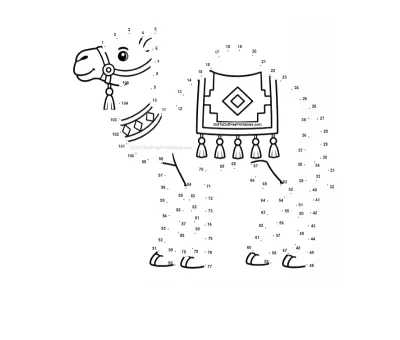
Connect 105 dots to reveal a camel striding across the sand, one of the most enduring symbols of life in the UAE and the wider Arabian Peninsula. With more dots than our other UAE puzzles, this one is a step up in challenge — great for kids ready to move past the easiest sheets while still learning something real about desert life.
Vanskelighet
Medium
!
Morsomt faktum: A camel's hump doesn't store water at all — it stores fat, which the camel's body can convert into both energy and water when food is scarce.
Last ned gratis utskrivbar PDF
Gratis for bruk hjemme og i klasserommet. Størrelse tilpasset papir i A4.
Foretrekker du Amerikansk brev? Last ned den versjonenIngen registrering nødvendig. Åpnes som PDF. Skriv ut på alle typer papir i amerikansk Letter-format (8,5 × 11 tommer). Gratis for bruk hjemme og i klasserommet.
← Tilbake til alle UAE-puslespillUAE Camel Prikk-til-prikk-puslespillguide
For thousands of years, the camel made life in the desert possible — carrying goods across dunes no wheeled cart could cross, providing milk, wool, and transport to Bedouin communities long before roads and air conditioning changed everything. Camels are still bred and raced across the UAE today, and camel milk shows up in everything from lattes to chocolate bars. This 105-dot puzzle is longer than most of our other sheets, so it's a nice next step once a child has a few easier puzzles under their belt. Find dot 1 and take it one hump at a time.
1–21 — The Head and Neck
Start at dot 1 and work through to dot 21 to draw the long, curving neck and alert head. Camels hold their necks in a distinctive S-curve, so encourage kids to let the line rise and fall naturally rather than forcing it straight. This is a big first stretch, so a short break afterward is fair.
Morsomt faktum!
Camels have three eyelids and two rows of long eyelashes, all working together to keep sand out of their eyes during a storm. They can also close their nostrils completely — a feature no other pack animal has quite like it.
Camels have three eyelids and two rows of long eyelashes, all working together to keep sand out of their eyes during a storm. They can also close their nostrils completely — a feature no other pack animal has quite like it.
22–42 — The First Hump
Continue from dot 22 to dot 42 to shape the tall, rounded first hump. This is a satisfying curve to draw — encourage a single smooth stroke rather than several small ones, since choppy lines tend to flatten the hump's shape.
Morsomt faktum!
The dromedary, or one-humped camel, is the type found throughout the UAE and the wider Arabian Peninsula. The two-humped Bactrian camel is a different species, native to Central Asia rather than the Gulf. Read more on <a href="https://en.wikipedia.org/wiki/Dromedary" target="_blank" rel="nofollow noopener noreferrer">Wikipedia's dromedary camel entry</a>.
The dromedary, or one-humped camel, is the type found throughout the UAE and the wider Arabian Peninsula. The two-humped Bactrian camel is a different species, native to Central Asia rather than the Gulf. Read more on <a href="https://en.wikipedia.org/wiki/Dromedary" target="_blank" rel="nofollow noopener noreferrer">Wikipedia's dromedary camel entry</a>.
43–63 — The Back Line
Trace dots 43 through 63 to complete the back line, including the dip after the hump. Getting the dip right — not too deep, not too flat — is what makes the silhouette read as a camel rather than just a lumpy line. Take this section slowly.
Morsomt faktum!
A fully grown camel can drink around 40 gallons of water in just a few minutes once it finally reaches a water source — replacing in one sitting what it lost over days of travel.
A fully grown camel can drink around 40 gallons of water in just a few minutes once it finally reaches a water source — replacing in one sitting what it lost over days of travel.
64–84 — The Legs
Connect dots 64 to 84 to draw the four long, sturdy legs. This section has more direction changes than the earlier ones, so it's a good spot to slow down and double-check each dot number before drawing the next line.
Morsomt faktum!
Camels walk by moving both legs on the same side of their body at once, a gait called pacing. It gives them a distinctive rocking motion, which is part of why an early nickname for the camel was 'ship of the desert.' Camel racing remains a major sport in the UAE — read more on <a href="https://en.wikipedia.org/wiki/Camel_racing" target="_blank" rel="nofollow noopener noreferrer">Wikipedia's camel racing entry</a>.
Camels walk by moving both legs on the same side of their body at once, a gait called pacing. It gives them a distinctive rocking motion, which is part of why an early nickname for the camel was 'ship of the desert.' Camel racing remains a major sport in the UAE — read more on <a href="https://en.wikipedia.org/wiki/Camel_racing" target="_blank" rel="nofollow noopener noreferrer">Wikipedia's camel racing entry</a>.
85–105 — The Feet and Tail
Finish the puzzle by connecting dots 85 through 105 to add the broad feet and the tail. Twenty-one dots left — a strong finish here really grounds the whole drawing, so encourage a steady hand right to the very last dot.
Morsomt faktum!
A camel's feet spread out as it steps down, distributing its weight so it doesn't sink into soft sand — much like a snowshoe does on snow. It's one of several features that make the camel so well suited to desert travel.
A camel's feet spread out as it steps down, distributing its weight so it doesn't sink into soft sand — much like a snowshoe does on snow. It's one of several features that make the camel so well suited to desert travel.
Fantastic work — your camel is ready to cross the dunes! Try warm sandy browns and tans for a realistic look, or have fun with bold, unexpected colours instead. Ready for a different kind of challenge? Explore more dot to dot printables 1-100 across other themes.
Flere gratis utskrivbare ark fra De forente arabiske emirater
Du liker kanskje også
Vanlige spørsmål
Ofte stilte spørsmål
Er UAE Camel egnet for alderen Alder 6–10?
Ja. Dette 105-prikk-puslespillet er laget for barn i alderen Alder 6–10.
Hvordan skriver jeg ut UAE Camel?
Bruk knappen for gratis nedlasting på denne siden, og skriv deretter ut PDF-filen hjemme eller på skolen.
Hva bør barn bruke for å fullføre dette puslespillet?
En blyant fungerer best til å sette sammen prikkene, og barna kan fargelegge det ferdige bildet etterpå.