Free Ocean Printable
Seahorse Dot-to-Dot Printable
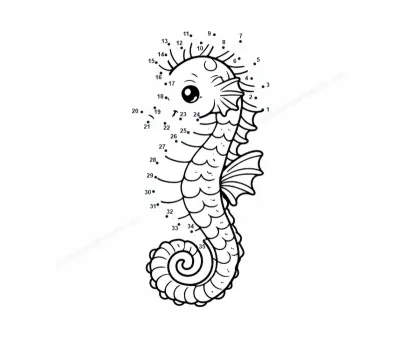
Connect the dots to reveal a charming seahorse floating through the sea! With just 35 easy dots, this puzzle is ideal for preschool and kindergarten children building number sequencing skills with an adorable ocean friend.
Difficulty
Easy
!
Fun fact: Seahorses are the only fish where the male carries and gives birth to the babies!
Download Free Printable PDF
Free for home and classroom use.
No sign-up needed. Opens as a PDF. Print on any US Letter (8.5 x 11 inch) paper. Free for home and classroom use.
Back to all ocean puzzlesSeahorse Dot-to-Dot Puzzle Guide
The seahorse is one of the most extraordinary creatures in the entire ocean — not just for how it looks, but for how it lives. It swims upright, it moves by flickering a tiny fin on its back, it anchors itself to seaweed with its curling tail, and the father is the one who carries and gives birth to the babies. If you were designing an animal from scratch, you would never imagine something this wonderfully unusual. Let's draw one together!
1–6 — The Head and Snout
Start at dot 1 and connect through to dot 6 to draw the seahorse's distinctive horse-like head and long, tube-shaped snout. This tiny section is a lovely, manageable start for younger children — just six dots to build confidence before the bigger sections ahead. The snout is one of the most unusual shapes in the animal kingdom.
Fun fact!
A seahorse has no teeth and no stomach. It sucks in tiny shrimp and plankton through its snout like a vacuum cleaner, and because food passes through so quickly, it must eat almost constantly — up to 3,000 brine shrimp per day. Being a seahorse is essentially a full-time eating job.
A seahorse has no teeth and no stomach. It sucks in tiny shrimp and plankton through its snout like a vacuum cleaner, and because food passes through so quickly, it must eat almost constantly — up to 3,000 brine shrimp per day. Being a seahorse is essentially a full-time eating job.
7–16 — The Curved Neck and Mane
Continue from dot 7 to dot 16 to trace the beautifully curved neck and the ridge along the back — sometimes called the seahorse's mane. This section has the loveliest curve in the whole puzzle. Children learn to follow a long, smooth arc, keeping their pencil moving slowly and evenly for the best result.
Fun fact!
Seahorses are genuinely one of the slowest fish in the ocean, moving at a top speed of about five feet per hour. To put that in perspective, a garden snail moves faster. Rather than chasing prey, the seahorse relies entirely on camouflage and surprise — drifting close to food and then striking with lightning speed.
Seahorses are genuinely one of the slowest fish in the ocean, moving at a top speed of about five feet per hour. To put that in perspective, a garden snail moves faster. Rather than chasing prey, the seahorse relies entirely on camouflage and surprise — drifting close to food and then striking with lightning speed.
17–26 — The Body Rings
Trace dots 17 through 26 to draw the distinctively segmented body — those raised bony rings that run from neck to tail. Children learn here that animal bodies are not always smooth, and begin to notice the beautiful structure of the seahorse's natural armour. This section rewards careful, deliberate dot-following.
Fun fact!
A seahorse is not covered in scales like most fish — instead its body is encased in bony plates arranged in rings. This makes it quite rigid, which is why it cannot wriggle like most fish. It is essentially wearing a suit of armour, which also makes it one of the toughest small creatures in the sea for a predator to swallow.
A seahorse is not covered in scales like most fish — instead its body is encased in bony plates arranged in rings. This makes it quite rigid, which is why it cannot wriggle like most fish. It is essentially wearing a suit of armour, which also makes it one of the toughest small creatures in the sea for a predator to swallow.
27–35 — The Curling Tail
Finish the puzzle by connecting dots 27 through 35 to draw the long, curling tail that sweeps beneath the body. The tail is one of the most satisfying shapes to draw — children practise a tight, diminishing spiral that is both challenging and deeply rewarding. Nine dots to the finish!
Fun fact!
The seahorse tail is prehensile — meaning it can grip things, just like a monkey's tail. Seahorses anchor themselves to coral and seaweed with their tails to avoid being swept away by currents. During mating, a male and female will wrap their tails together and drift through the water side by side — one of the most romantic sights in the ocean.
The seahorse tail is prehensile — meaning it can grip things, just like a monkey's tail. Seahorses anchor themselves to coral and seaweed with their tails to avoid being swept away by currents. During mating, a male and female will wrap their tails together and drift through the water side by side — one of the most romantic sights in the ocean.
Lovely work — your seahorse is complete! Did you know seahorses come in over 45 different species, in colours ranging from bright yellow to deep purple to almost completely transparent? Colour yours however you like — in the seahorse world, anything goes.
More free ocean printables