Nauka
Dlaczego puzzle typu „kropka-kropka” dobrze sprawdzają się u dzieci i dorosłych niewidomych na kolory
A veteran nauczyciel on why kropka-to-kropka łamigłówki can work well for color blind dzieci - and why adults enjoy them too.
Introduction
I've been teaching for more than twenty years, and one thing I've learned is that the moments that stick with you aren't always the big ones. Sometimes it's something small — a kid quietly pushing a karta pracy to the side, not making a fuss, just kind of... checking out. You notice it if you're paying attention.
For years I didn't fully understand why some of my students did this with certain aktywności. Then one spring, a parent came in for a conference and mentioned, almost as an aside, that her son had been diagnosed with red-green color blindness. And suddenly about a dozen small moments clicked into place.
He wasn't disengaged. He was lost. And no one had handed him something he could actually do — until we started using kropka-to-kropka łamigłówki.
Co to jest ślepota barw? Proste wyjaśnienie dla rodziców
Najpierw wyjaśnijmy powszechne błędne przekonanie: ślepota barw prawie nigdy nie oznacza, że widzisz tylko czerń i biel. Zdecydowana większość osób niewidomych na kolory widzi kolory – ale nie w pełnym zakresie, który większość ludzi uważa za oczywistość. Do tego stanu dochodzi, gdy pewne komórki oka (tzw. czopki) nie przyjmują koloru tak, jak powinny.
Zdecydowanie najczęstszym typem jest ślepota na barwy czerwono-zielone, która sprawia, że trudno jest odróżnić kolor czerwony od zielonego. Istnieje również ślepota barw niebiesko-żółtych, która jest rzadsza, i całkowita ślepota barw, która jest jeszcze rzadsza.
Według National Eye Institute około 1 na 12 mężczyzn i 1 na 200 kobiet pochodzenia północnoeuropejskiego ma pewną postać daltonizmu.
If your child seems to struggle with color-based aktywności, calls colors by the wrong names, or avoids art projects, it's worth a conversation with your eye doctor. The test itself is simple and takes just a few minutes.
Problem z większością zajęć dla dzieci
Here's what I wish more nauczyciele and rodzice understood: an enormous amount of what we put in front of dzieci relies on color as a core mechanic. Not as decoration — as an actual instruction.
Color-by-number worksheets. Matching games sorted by color. Board games where your piece is identified by its color. Science aktywności where you circle "all the red ones." Math sheets where you "color the even numbers blue." Even many simple card games.
Every single one of those aktywności has a hidden barrier built right into it for a color blind child. And the frustrating part is that the child usually doesn't protest. They just get quiet. They guess. They copy a neighbor without anyone realizing why. Over time, that quiet struggle can chip away at their pewność siebie in ways that are hard to see from the outside.
Widziałem, jak to się stało. A kiedy już to zobaczysz, nie możesz tego odzobaczyć.
Dlaczego puzzle od kropki do kropki są zupełnie inne
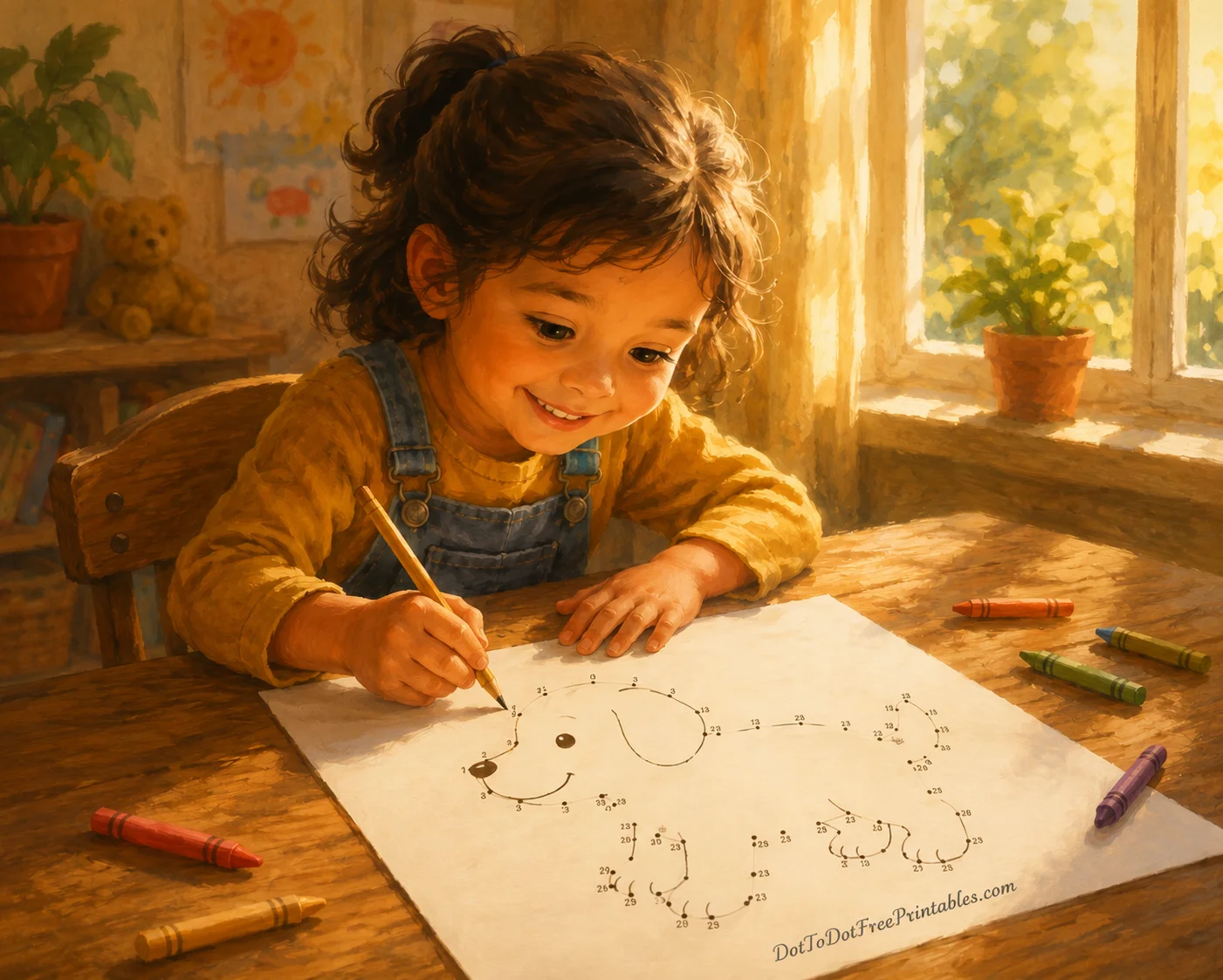
This is what I love about kropka-to-kropka łamigłówki, and why I started keeping a stack of them in my klasa years before I fully understood the science behind it: they work entirely on sequence and space. A black kropka. A white page. A number. A pencil. That's the whole game.
There is no color instruction anywhere in the aktywność. You don't need to find the red kropka or match the green piece. You just find the next number. For many dzieci with color blindness, that's a much fairer playing field — and often a welcome break from color-based klasa tasks.
The skills a kropka-to-kropka łamigłówka actually tests are number recognition, the ability to count in sequence, fine motor control as you draw each line, and spatial awareness as the image slowly takes shape. Color perception is not on that list. It never was.
To nie jest drobnostka. O to właśnie chodzi.
Uspokajająca strona, którą dorośli odkrywają na nowo
Something interesting happens when adults pick up a kropka-to-kropka łamigłówka for the first time in twenty years. They expect to feel silly. Then, about three minutes in, they go quiet.
There's a reason for that. Psychologists talk about something called flow state — the mental zone where you're focused enough to be fully present but not so stretched that you feel stressed. Dot-to-kropka łamigłówki can encourage that kind of skupienie. The next step is always clear. The progress is visible with every line you draw. And the payoff — watching an image appear from nothing — is quietly satisfying in a way that's hard to explain but łatwe to feel.
For adults dealing with stress, anxiety, or just the mental noise of a long day, these łamigłówki offer something that screens rarely do: a task with a beginning, a middle, and an actual end. Your hands are busy. Your mind gets to rest. And when you put the pencil down, something is finished.
For color blind adults specifically, this is worth saying plainly: unlike adult coloring books — which have had a huge and well-deserved moment as a stress relief aktywność — kropka-to-kropka łamigłówki require absolutely nothing from your color vision. No choosing shades. No second-guessing whether that's green or brown. Just numbers, kropki, and the quiet satisfaction of a line landing exactly where it should.
Jak to wpływa na pewność siebie dzieci
I want to come back to that boy from my class, because his story didn't end with me just handing him a kropka-to-kropka sheet and walking away.
What I noticed — and what I've now noticed with other color blind students over the years — is what happens to a child when they find something they can do without any workaround. No asking for help. No copying. No quiet guessing. Just doing the aktywność, finishing it, and looking up with that expression that means: I did that.
Confidence in dzieci is not a fixed trait. It's built, piece by piece, from small experiences of competence. Every time a child with color blindness completes an aktywność that didn't require them to navigate around their vision, they collect a small piece of evidence that they are capable. And those pieces add up.
Dot-to-kropka łamigłówki also reinforce real academic skills — kolejność liczb, counting, fine motor control — without any of the color dependency that makes so many other aktywności quietly unfair. That means a color blind child isn't just having zabawa. They're building the same foundations as every other kid at the table, on exactly the same terms.
That's what inclusion actually looks like in practice. Not a modified version of the aktywność. The same aktywność, for everyone.
Bezpłatne puzzle kropka-kropka do wydrukowania — wydrukuj je już dziś
If any of this resonated with you — whether you're a parent of a color blind child, a nauczyciel looking for aktywności that work for every student, or an adult who just wants something calming and screen-darmowe to do in the evenings — I'd point you straight to DotToDotFreePrintables.com.
Każdy plik PDF do druku z kropkami jest darmowy do pobrania i wydrukowania. Wszystkie są czarno-białe, co oznacza brak zależności od koloru, i dostępne są w gamie kropek do druku od 1 do 100 i większej — od prostych 10-kropkowych kształtów dla maluchów po skomplikowane sceny z 200 kropkami dla starszych dzieci i dorosłych.
Wydrukuj jeden. Chwyć ołówek. Zacznij od numeru jeden. I zobacz, co się pojawi.
In twenty years of teaching, I've handed out a lot of aktywności. These are one of the handful I'd feel comfortable offering across a wide range of ages and abilities — simple to adapt, łatwe to drukuj, and fairer for dzieci who struggle with color-based tasks.