Leren
Waarom punt-tot-punt-puzzels een van de beste dingen zijn die je een jong kind kunt geven
A veteran primary school leerkracht on how verbind-the-punten builds potloodcontrole, number sense, and quiet zelfvertrouwen — one line at a time.
Introduction
I've been teaching primary school for a long time, and there is one thing I know with absolute certainty: the activiteiten that look the simplest are often doing the most work. These verbind-the-punten activiteiten are exactly like that. To a passing adult, a child connecting numbered punten looks like idle amusement. What's actually happening is something else entirely.
In more than two decades in the klas — working with kinderen in small districts in rural Georgia and busy elementary schools on the outskirts of Houston — I have watched kinderen sit down with a printbare page and, without any prompting, find their counting, slow their hand, and stay focused for longer than they would for almost any other task. This is my attempt to explain why.
De hand leert door te doen
Fine motor development is one of the things ouders hear about most in the early years, and for good reason. The CDC's developmental milestone guidelines include pencil and drawing skills as key markers through age five, and occupational therapists across the country flag potloodcontrole as a foundation for early writing success. Children don't strengthen their pencil grip through lectures about how to hold a pencil. They do it through sustained, purposeful mark-making.
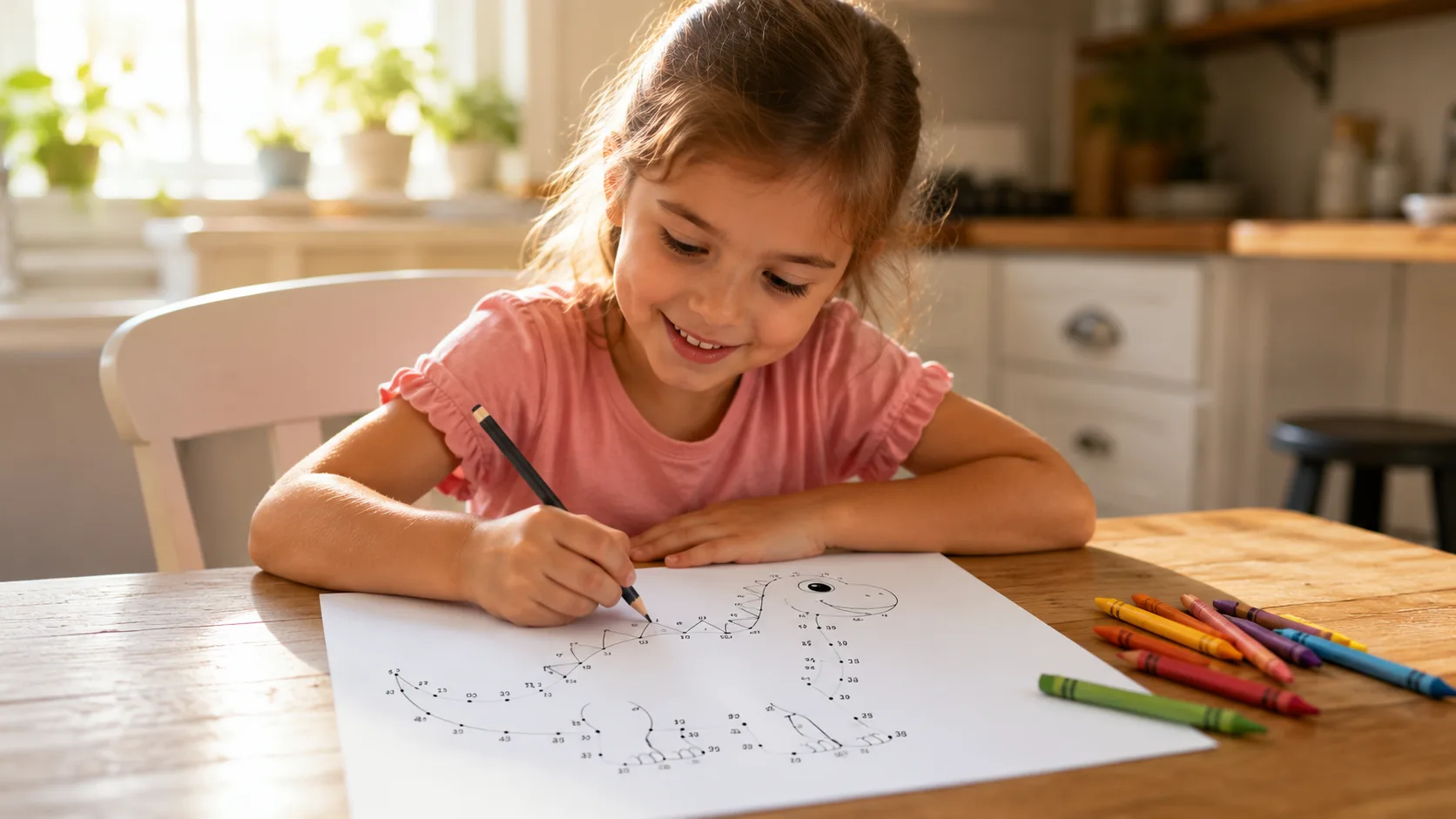
What these activiteiten do is give a child a reason to draw carefully. The punt is small. The line needs to land on it. That combination — intentional movement toward a visible target — is exactly the kind of practice that builds hand-eye coordination and fine motor control in jonge kinderen.
I've noticed that kinderen who do a lot of verbind-the-punten activiteiten tend to hold the pencil with more zelfvertrouwen over time. Their lines become more deliberate. They start to trust their hands to do what they tell them. That trust, once it arrives, transfers directly into their early writing.
Achter elkaar tellen is een andere vaardigheid dan hardop tellen
Most kinderen can recite numbers from one to twenty without much trouble. But counting in sequence — starting from any given number and following the chain to the next — is a more nuanced skill, and it's one that verbind-the-punten activiteiten practice constantly. Under the Common Core counting and cardinality standards used in most US states, kindergarteners are expected to count sequences to 100 and understand number order. Dot-to-punt worksheets give kinderen a reason to practice exactly that — without it feeling like drill work.
When a child scans the page looking for number fourteen after drawing a line to thirteen, they're not just remembering a list. They're locating a number in space, holding the sequence in mind, and making a decision about where to move next. That's a small but genuine cognitive task, and it happens dozens of times in the span of a single printbare verbind-the-punten werkblad.
For kinderen who are just leren their teens, or who confuse twenty-three with thirty-two, this kind of repeated, low-pressure practice is invaluable. They're not being tested. They're just looking for the next punt. The leren sneaks in sideways, which is often the best way for it to arrive.
Op het moment dat de foto verschijnt
Here's something I always try to remember: kinderen are motivated by seeing results. Abstract effort — studying, practising, repeating — is genuinely hard for jonge kinderen to sustain because the payoff is invisible.
These activiteiten solve this problem beautifully. As the lines accumulate, the image forms. A fin appears. A tail emerges. Suddenly there's a whale where there used to be nothing but numbered punten — something our ocean-themed punt-to-punt collection captures wonderfully. Children respond to this in the most joyful way — they feel accomplished, surprised, and proud all at once. They want to colour it. They want to do another one.
That feeling of completion matters more than it might seem. It builds the habit of seeing a task through to the end. And for kinderen who often feel uncertain about their abilities, finishing a verbind-the-punten activiteit and seeing something wonderful appear is a small but real piece of evidence that they can do hard things. You can watch that zelfvertrouwen settle on their face.
Choosing the right printbare for your child
Niet alle verbind-de-punten-printables voor kinderen zijn hetzelfde, en de beste voor een kind is degene die precies op de grens van zijn of haar huidige niveau ligt. Te makkelijk, en het houdt de aandacht niet vast. Te moeilijk, en frustratie slaat toe voordat de afbeelding klaar is.
For very jonge kinderen or beginners, I'd start with sheets in the one-to-ten range. For kinderen confident counting to twenty, step up to worksheets with twenty-five or thirty punten. Theme matters too — I've seen kinderen in California classrooms push through a harder sheet simply because it shows a T. rex at the end. Our dinosaur punt-to-punt puzzels are particularly popular with that crowd.
Printable activiteit sheets are wonderful for this because you can try a range without any commitment. Print one, sit quietly with the child, watch how they respond, and adjust from there. The right level is the one where they grumble just a little at the hard parts — and then keep going anyway.
Final thoughts
What I've come to believe, after years in the klas, is that the best leren activiteiten are the ones kinderen don't experience as leren at all. They're just doing something they enjoy.
Deze printbare werkbladen vallen precies in die categorie: stil, draagbaar, schermvrij en ze doen op een rustige manier iets belangrijks. De American Academy of Pediatrics pleit al lange tijd voor spelenderwijs en schermvrij spelen voor jonge kinderen, en deze gratis punt-tot-punt-werkbladen passen daar perfect bij. Ze zijn een van de weinige echt goede dingen die je een jong kind kunt geven, en ik word er nooit moe van om een kind het laatste puntje te zien verbinden.