Learning
How Dot to Dot Puzzles Help Children Learn
What actually happens when a child connects the dots: number recognition, pencil control, focus, and the quiet confidence of finishing something.
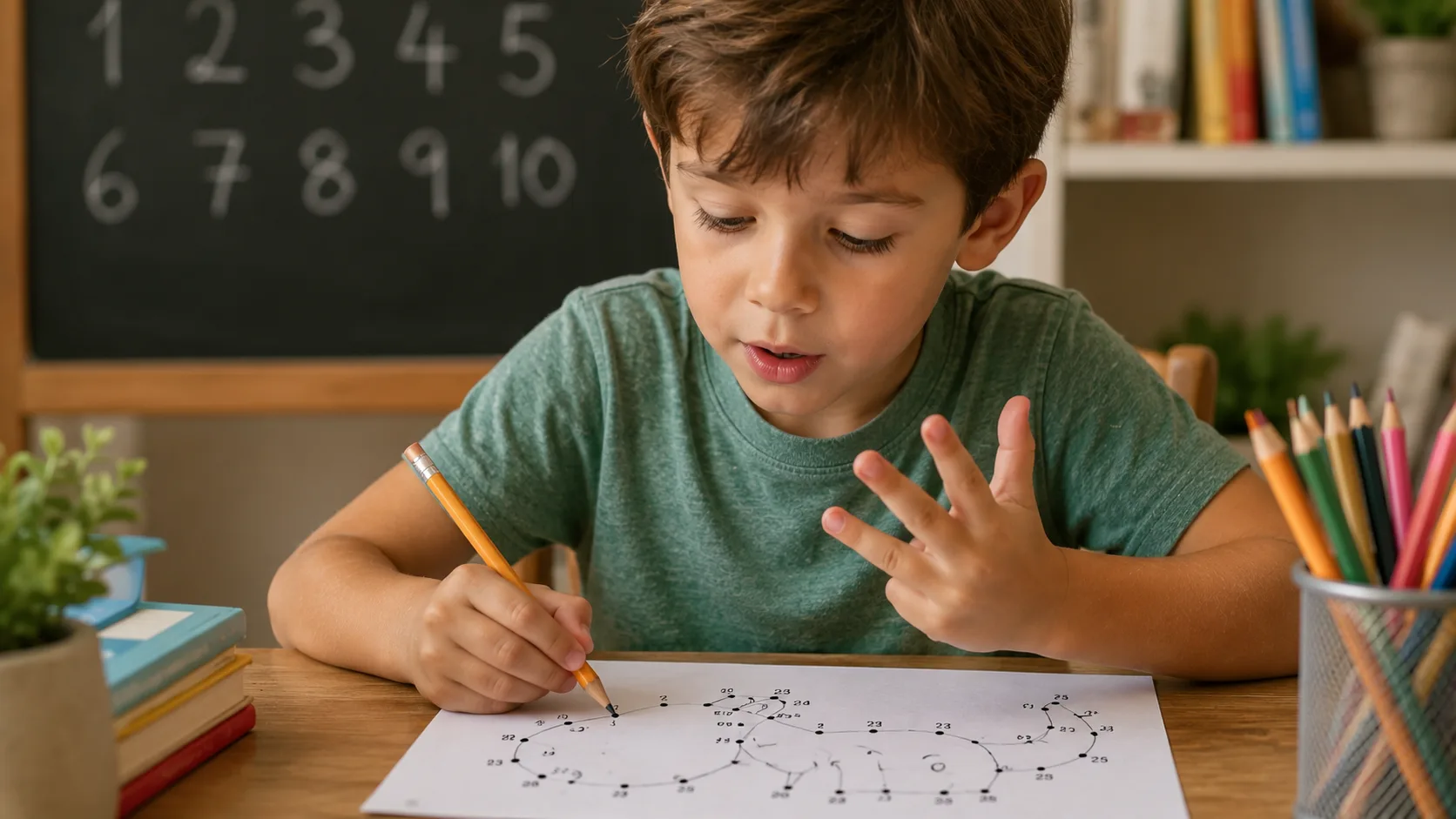
A dot to dot puzzle looks like the least ambitious activity on the table. A page of numbered dots, a pencil, ten minutes. But watch a five-year-old work through one and you'll see several things happening at once: they're reading numbers, holding a sequence in their head, steering a pencil toward a small target, and checking their own work when a line goes astray. Few single worksheets cover all of that at once; dot to dot covers several of these at the same time.
This guide walks through the specific skills a connect-the-dots page practices, what educators and developmental guidelines say about each one, and what adults can do to get the most out of the activity — without turning it into a lesson.
Number recognition and sequencing, without the drill
The core mechanic of every dot to dot puzzle is finding the next number. That sounds trivial, but it isn't. A child who can chant one-to-twenty out loud still has to do real work to spot the numeral 14 among a scatter of other numbers, confirm it comes after 13, and move to it. That's number identification plus ordering — exactly the skills covered by the kindergarten counting and cardinality standards used across most US states.
The repetition matters. A 30-dot puzzle asks the same question — what comes next? — thirty times in a row, and the child answers it voluntarily because they want to see the picture. Try getting thirty answers out of a flashcard session with the same enthusiasm.
For children still shaky on the teens, or who flip 23 and 32, this low-pressure repetition is where the confusion gets sorted out. Nobody is grading them. They're just looking for the next dot.
Pencil control: small targets teach steady hands
Fine motor control develops through purposeful mark-making, not instruction. The CDC's developmental milestones track drawing and pencil skills as key markers through age five for exactly this reason: a hand that has practiced landing a line on a small dot is a hand that's getting ready to form letters.
A dot to dot page is unusually good practice because the target is specific. The line has to start at one dot and end at another. Coloring is looser; tracing can feel like a chore. Connecting dots gives the same practice with a built-in reason to be careful — a sloppy line makes a wobbly whale, and children notice.
Focus and finishing: why the picture matters
Young children struggle to sustain effort when the payoff is invisible. Dot to dot puzzles solve this structurally: every line drawn is visible progress, and the emerging picture keeps pulling the child forward. A fin appears, then a tail, and suddenly the child wants to know what it is more than they want to stop.
That pull toward completion is worth more than it looks. Finishing a page — and holding up something recognizable at the end — builds the habit of seeing a task through. For a child who often abandons activities halfway, a 20-dot puzzle is a finish line they can actually reach. Once they've reached a few, longer pages stop feeling impossible.
Themes help here. A child who loves sea creatures will push through a harder ocean dot to dot page just to find out whether it's a dolphin or a shark. A dinosaur-obsessed six-year-old will do the same for a T. rex puzzle. Interest buys persistence.
How adults can help (mostly by staying out of the way)
Let the child lead. If they get stuck, resist the urge to point — ask "what number comes after 16?" and let them do the finding. The searching is the learning; doing it for them removes the useful part.
Praise the effort you actually saw, not the speed. "You kept going even when you couldn't find 24" lands better than "you're so fast," and it rewards the behavior you want repeated.
When the puzzle is done, extend it. Invite the child to color the picture, or ask them to tell you a story about it — where does this whale live, what is it looking for? Two minutes of that turns a counting exercise into language practice, and it signals that the finished page is worth something.
One honest caveat: dot to dot puzzles are practice, not a curriculum. They reinforce counting and pencil control; they don't teach a child numbers from scratch. If a child doesn't recognize numerals yet, start with a 1–10 page and sit alongside them the first few times.
The best early-learning activities are the ones children don't experience as learning. Dot to dot puzzles earn their place on that short list: free to print as a pdf, quiet, screen-free, and quietly working on four or five skills at once. Pick a theme your child already loves, start easier than you think you need to, and let the picture do the motivating.