America 250 Years
Eagle Banner Dot to Dot — Free 104-Dot Printable for Ages 6–9
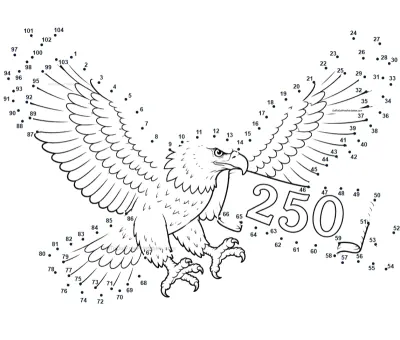
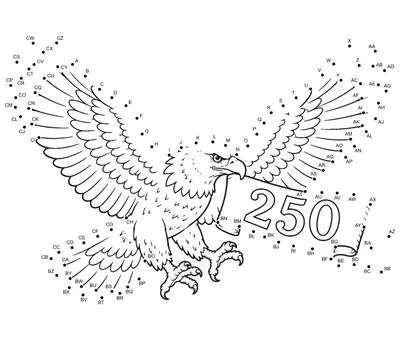
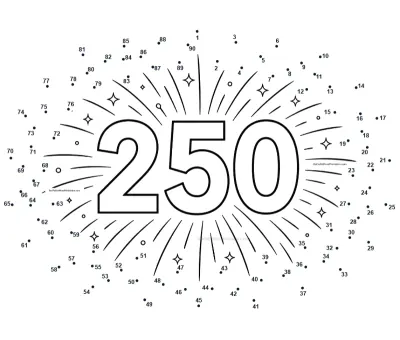
Connect 104 dots to reveal a majestic American Bald Eagle carrying a patriotic banner to celebrate America's 250th anniversary! This free printable worksheet helps children practise number sequencing and concentration while honouring one of America's most powerful symbols of freedom and strength. Perfect for ages 6–9.
Difficulty
Hard
Fun fact: The Bald Eagle was chosen as the national symbol of the United States in 1782. It appears on the Great Seal of the United States, the President's flag, and countless official emblems — representing freedom, strength, and the enduring spirit of the American republic.
Downloaded11+timesYou’ve made a great choice!
Downloads now start from the button below. Tap it to get this puzzle's PDF.
Number Version
Connect the numbered dots from 1 to the end to reveal the picture.
Free for home and classroom use.
Alphabet Version
Includes alphabet-themed design for easy learning.
No sign-up needed. Opens as a PDF. Print on US Letter (8.5 × 11 inch) or A4 paper. Free for home and classroom use.
America 250 Years
You might also like
Ages 6–9 — Hard
How to Solve the America 250 Eagle Banner Dot-to-Dot Puzzle
America is turning 250 years old — and no symbol captures that spirit better than the mighty Bald Eagle! For 244 years the eagle has graced the Great Seal of the United States, soaring as the living emblem of freedom. Today your eagle is clutching a banner to proclaim America's greatest birthday. Grab a pencil, find dot 1, and let's help this eagle take flight!
1–22 — The Eagle's Head and Beak
Start at dot 1 and connect through to dot 22 to trace the bold, proud head of the Bald Eagle — including its sharp, curved beak. Children practise short directional strokes and gentle curves here, building pencil control while forming the eagle's most recognisable feature.
Fun fact!
The Bald Eagle is not actually bald! Its name comes from an old English word "balde," meaning white. The striking white head feathers appear when the bird reaches adulthood at around five years old. Before that, young eagles have mottled brown and white plumage.
The Bald Eagle is not actually bald! Its name comes from an old English word "balde," meaning white. The striking white head feathers appear when the bird reaches adulthood at around five years old. Before that, young eagles have mottled brown and white plumage.
23–46 — The Wingspan — Left Wing
Continue from dot 23 to dot 46 to sweep out the eagle's powerful left wing. These long, flowing strokes are excellent practice for children developing arm movement and large-scale pencil control. Encourage a smooth, confident stroke from shoulder to wingtip.
Fun fact!
A Bald Eagle's wingspan can reach up to 2.4 metres (nearly 8 feet) from tip to tip — about as wide as a small car is long! Those enormous wings allow the eagle to soar for hours on rising columns of warm air called thermals, barely flapping at all.
A Bald Eagle's wingspan can reach up to 2.4 metres (nearly 8 feet) from tip to tip — about as wide as a small car is long! Those enormous wings allow the eagle to soar for hours on rising columns of warm air called thermals, barely flapping at all.
47–70 — The Wingspan — Right Wing
Mirror the left wing by connecting dots 47 to 70 to form the right wing. Symmetry is an important visual concept for young learners, and completing both wings gives a satisfying sense of balance and achievement. Notice how the strokes now sweep in the opposite direction.
Fun fact!
Eagles have up to 7,000 feathers covering their bodies, each one precisely shaped for its role — broad flight feathers for lift, soft body feathers for insulation, and stiff tail feathers for steering. They moult and regrow feathers gradually so they can always fly.
Eagles have up to 7,000 feathers covering their bodies, each one precisely shaped for its role — broad flight feathers for lift, soft body feathers for insulation, and stiff tail feathers for steering. They moult and regrow feathers gradually so they can always fly.
71–88 — The Talons and Patriotic Banner
Connect dots 71 to 88 to draw the eagle's powerful talons gripping the flowing anniversary banner. Children practise sharp angled lines and curved ribbon shapes — more demanding strokes that reward careful attention and steady hand control.
Fun fact!
An eagle's talons can exert an estimated gripping force of around 400 pounds per square inch (psi) — far stronger than the average human hand. Talons are used to catch fish and small mammals, and the eagle's grip is so firm that prey rarely escapes once caught.
An eagle's talons can exert an estimated gripping force of around 400 pounds per square inch (psi) — far stronger than the average human hand. Talons are used to catch fish and small mammals, and the eagle's grip is so firm that prey rarely escapes once caught.
89–104 — The Stars, Shield, and Finishing Details
Complete the puzzle by connecting dots 89 to 104 to add the patriotic stars, shield markings, and final details that make this eagle truly American. Take your time on these last dots — a steady finish here pulls the whole picture together beautifully.
Fun fact!
The Great Seal of the United States shows the Bald Eagle holding an olive branch in one talon (representing peace) and a bundle of 13 arrows in the other (representing readiness to defend freedom). The eagle faces the olive branch, which is often read as a symbol of America's preference for peace.
The Great Seal of the United States shows the Bald Eagle holding an olive branch in one talon (representing peace) and a bundle of 13 arrows in the other (representing readiness to defend freedom). The eagle faces the olive branch, which is often read as a symbol of America's preference for peace.
Outstanding work — your America 250 Eagle is soaring high with the anniversary banner! That's 104 dots and one mighty symbol of American freedom. Colour the eagle's white head, brown wings, and bright yellow beak, then fill the banner with red, white, and blue. Happy 250th birthday, USA! Explore more America 250 dot to dot printables to keep the fun going.
Coloring Guide
America 250 Eagle Banner: Classic Real-Life Colors
A bald eagle is really white, brown and yellow; this palette swaps in flag red and blue for the celebration.
| Dot Range | Part | Color | Why this color | |
|---|---|---|---|---|
| Numeric | Alphabet | |||
| 1–22 | A–V | The Eagle's Head and Beak | Crayola Scarlet | An adult eagle's head is bright white and its beak yellow; red marks the head out in the anniversary scene. |
| 23–46 | W–AT | The Wingspan — Left Wing | Crayola Sky Blue | The dark-brown wing spans nearly eight feet and rides warm thermals; blue stands in for its huge sweep. |
| 47–70 | AU–BR | The Wingspan — Right Wing | Crayola Goldenrod | The matching wing carries some of the bird's 7,000 feathers; warm gold catches it in the light. |
| 71–88 | BS–CJ | The Talons and Patriotic Banner | Crayola Scarlet | Talons grip near 400 psi; red suits both them and the ribbon they hold, like the one on the Great Seal. |
| 89–104 | CK–CZ | The Stars, Shield, and Finishing Details | Crayola Sky Blue | The Great Seal shield and its stars sit on blue, the flag's true field colour. |
America 250 Eagle Banner: Soft Natural Colors
Bright open sky lifts the eagle's plumage and banner to pale, sunlit silver, tan and green.
| Dot Range | Part | Color | Why this color | |
|---|---|---|---|---|
| Numeric | Alphabet | |||
| 1–22 | A–V | The Eagle's Head and Beak | Crayola Silver | Seen against the sky the white head glows almost silver. |
| 23–46 | W–AT | The Wingspan — Left Wing | Crayola Tan | Sun through the left wing's feathers warms their brown to a pale tan. |
| 47–70 | AU–BR | The Wingspan — Right Wing | Crayola Sea Green | Soft green suits the shaded underside of the right wing. |
| 71–88 | BS–CJ | The Talons and Patriotic Banner | Crayola Silver | A banner snapping in bright sun looks bleached silver along its folds. |
| 89–104 | CK–CZ | The Stars, Shield, and Finishing Details | Crayola Tan | Pale gold-tan fits the shield's stars catching full daylight. |
America 250 Eagle Banner: Bold Real-Life Colors
Deep browns and iron tones show the eagle as the powerful bird of prey behind the emblem.
| Dot Range | Part | Color | Why this color | |
|---|---|---|---|---|
| Numeric | Alphabet | |||
| 1–22 | A–V | The Eagle's Head and Beak | Crayola Forest Green | A dark shade gives the hooked beak and brow the heavy look of a real hunter. |
| 23–46 | W–AT | The Wingspan — Left Wing | Crayola Brown | Brown is the eagle's true wing colour, built from thousands of dark flight feathers. |
| 47–70 | AU–BR | The Wingspan — Right Wing | Crayola Orange | Burnt orange picks out the second wing like feathers lit by a low sun. |
| 71–88 | BS–CJ | The Talons and Patriotic Banner | Crayola Forest Green | Strong green suits the talons locking onto the heavy anniversary banner. |
| 89–104 | CK–CZ | The Stars, Shield, and Finishing Details | Crayola Brown | Deep brown fits a shield stamped on old painted metal, with its 13 arrows. |
Why Is the America 250 Eagle Banner Dot to Dot Printable Rated Hard?
The America 250 Eagle Banner is rated hard. Its 104 dots are 40 straight, 11 curved, 13 zigzag and 40 sharp-turn dots. The stretches to slow down for are wingspan — left wing at dots 24–25 and wingspan — right wing at dots 51–54. Follow the numbered order even when another dot looks nearer, and check the next number before each turn.
Straight
40 dots · 38%
Easiest — join two dots with one straight pencil stroke.
Curved
11 dots · 11%
57 58
Zigzag
13 dots · 13%
Quick in-and-out changes of direction. Good counting practice.
Sharp turns
40 dots · 38%
35 42
We traced all 104 dots on this exact worksheet by hand — the sharp turns at dots 24–25 is where it got tricky, and you can check that against your own printout.
Key Sections to Know
Every notable stretch of the path, dot by dot.
| Dot Range | Pattern | Why It Matters | |
|---|---|---|---|
| Numeric | Alphabet | ||
| 24 25 | X Y | Sharp turns | The line changes direction hard at dots 24–25, on wingspan — left wing — stop at 24, find 25, then turn. |
| 29 30 | AC AD | Sharp turns | Dots 29–30 cut a sharp corner at wingspan — left wing; lift your eyes to dot 30 before drawing it. |
| 32 33 | AF AG | Sharp turns | Expect an abrupt turn on wingspan — left wing between dots 32 and 33, so pause before joining them. |
| 35 42 | AI AP | Sharp turns | There is a tight angle at wingspan — left wing here; treat dots 35 and 42 as two separate short lines. |
| 51 54 | AY BB | Sharp turns | The line changes direction hard at dots 51–54, on wingspan — right wing — stop at 51, find 54, then turn. |
| 57 58 | BE BF | Curved | Follow wingspan — right wing as it curls from dot 57 to dot 58, easing the line rather than snapping it. |
Bottom line: The America 250 Eagle Banner dot to dot is hard rated — 49% smooth lines with just 5 short sections to watch for.