America 250 Years
Eagle Kite Dot to Dot — Free 80-Dot Printable for Ages 5–8
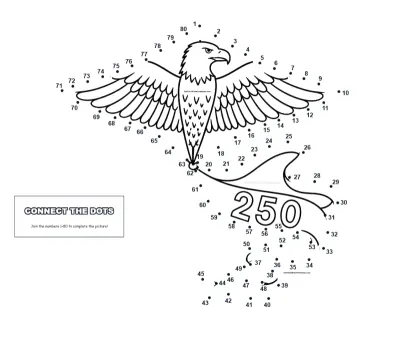
Connect 80 dots to reveal a majestic bald eagle soaring high with a patriotic banner to celebrate America's 250th anniversary! This free printable worksheet builds number sequencing and fine motor skills while sparking pride in 250 years of American history. Perfect for children aged 5–8.
Difficulty
Medium
Fun fact: The bald eagle was adopted as part of the Great Seal of the United States in 1782 — just six years after the Declaration of Independence was signed. It is now the official national bird, and its image appears on passports, coins, and official government documents to this day!
Downloaded2+timesYou’ve made a great choice!
Downloads now start from the button below. Tap it to get this puzzle's PDF.
Free for home and classroom use.
No sign-up needed. Opens as a PDF. Print on US Letter (8.5 × 11 inch) or A4 paper. Free for home and classroom use.
America 250 Years
You might also like
Ages 5–8 — Medium
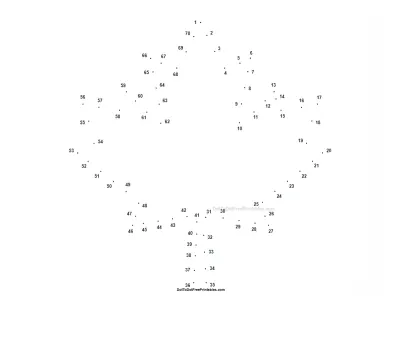
How to Solve the Eagle Kite Banner America 250 Dot-to-Dot Puzzle
America is celebrating its 250th birthday, and the nation's most iconic symbol — the bald eagle — is here to lead the festivities! With a patriotic banner streaming behind it, this majestic bird soars high over the celebration. Eagles have stood for American freedom and strength since the very earliest days of the republic. Grab your pencil, find dot 1, and let's send this eagle soaring!
1–16 — The Eagle's Head and Beak
Start at dot 1 and connect through to dot 16 to trace the eagle's bold white head and sharp, curved beak. These carefully directed strokes help children warm up their pencil grip and build the confident hand control they'll need for the wings ahead. Encourage them to draw slowly and aim for each dot precisely.
Fun fact!
Bald eagles are not actually bald — their name comes from an old English word "balde," meaning white. The striking white head feathers appear when the bird reaches adulthood at around five years old. Before that, young eagles have brown and white mottled plumage that makes them much harder to recognise.
Bald eagles are not actually bald — their name comes from an old English word "balde," meaning white. The striking white head feathers appear when the bird reaches adulthood at around five years old. Before that, young eagles have brown and white mottled plumage that makes them much harder to recognise.
17–36 — The Outstretched Wings
Continue from dot 17 to dot 36 to draw the eagle's powerful, outstretched wings — the most dramatic part of the picture. These long, sweeping strokes from wingtip to body are a wonderful exercise for wrist flexibility and smooth line control. Children practise holding a consistent direction across a larger stretch of the page.
Fun fact!
A bald eagle's wingspan can reach up to 2.4 metres — almost eight feet from tip to tip — making it one of the largest birds of prey in North America. Those massive wings allow eagles to soar on thermal currents of warm rising air for hours without a single wingbeat, covering enormous distances with very little effort.
A bald eagle's wingspan can reach up to 2.4 metres — almost eight feet from tip to tip — making it one of the largest birds of prey in North America. Those massive wings allow eagles to soar on thermal currents of warm rising air for hours without a single wingbeat, covering enormous distances with very little effort.
37–54 — The Tail Feathers and Talons
Trace dots 37 through 54 to add the fan of white tail feathers and the powerful curved talons below. Children practise a mix of fanning strokes for the feathers and sharp, precise curves for each talon — a great combination for building both fluency and control in a single section.
Fun fact!
An eagle's talons are its primary hunting tool, with some estimates putting their gripping force at around 400 pounds per square inch — many times stronger than a human hand. The bald eagle also has a specially rough, spiky texture on the soles of its feet called spicules, which help it grip slippery fish pulled straight from rivers and lakes.
An eagle's talons are its primary hunting tool, with some estimates putting their gripping force at around 400 pounds per square inch — many times stronger than a human hand. The bald eagle also has a specially rough, spiky texture on the soles of its feet called spicules, which help it grip slippery fish pulled straight from rivers and lakes.
55–68 — The Patriotic Banner
Connect dots 55 through 68 to draw the flowing banner that streams behind the eagle. The ribbon-like curves of a banner in motion are a brilliant challenge for smooth, flowing line work. Encourage children to imagine the banner fluttering in a summer breeze as they draw each gentle arc.
Fun fact!
The bald eagle holds a banner or ribbon in its beak on many famous American emblems and seals. On the Great Seal of the United States, the eagle holds a ribbon reading "E Pluribus Unum" — Latin for "Out of Many, One" — a motto that has appeared on American coins and documents for generations.
The bald eagle holds a banner or ribbon in its beak on many famous American emblems and seals. On the Great Seal of the United States, the eagle holds a ribbon reading "E Pluribus Unum" — Latin for "Out of Many, One" — a motto that has appeared on American coins and documents for generations.
69–80 — The Stars and Finishing Touches
Finish the puzzle by connecting dots 69 through 80 to add the patriotic stars and the final celebratory details that bring the whole scene to life. Just twelve dots to complete the picture — encourage children to slow down and make these last lines their very best. A clean, careful finish is the mark of a true dot to dot champion!
Fun fact!
The 50 stars on the American flag each represent one of the 50 states in the union. The flag has been updated 27 times as new states joined — the most recent change came in 1960, when Hawaii's star was added. The current 50-star design has now been the official flag for longer than any other version in American history.
The 50 stars on the American flag each represent one of the 50 states in the union. The flag has been updated 27 times as new states joined — the most recent change came in 1960, when Hawaii's star was added. The current 50-star design has now been the official flag for longer than any other version in American history.
Magnificent work — your America 250 eagle is soaring with pride! That's 80 dots and one spectacular symbol of American freedom. Colour the eagle in brown and white, the banner in red and gold, and the stars in red, white, and blue to give America the most patriotic 250th birthday tribute possible. Happy anniversary, USA! Discover more america 250 printables to keep the celebration going.
Coloring Guide
Eagle Kite Banner America 250: Classic Real-Life Colors
A bald eagle's real colours are white, dark brown and yellow; this set swaps in flag reds and blues for the celebration.
- 1–16 (The Eagle's Head and Beak): Crayola Scarlet — An adult bald eagle's head is actually bright white, earned around age five; here red marks it out in the party scene.
- 17–36 (The Outstretched Wings): Crayola Sky Blue — The outstretched wings really are dark brown and span up to eight feet; blue stands in for that huge shape.
- 37–54 (The Tail Feathers and Talons): Crayola Goldenrod — The tail fans white and the talons are yellow with a roughly 400-psi grip; gold suits the bony feet.
- 55–68 (The Patriotic Banner): Crayola Scarlet — Eagles on US seals hold a ribbon like this one; red is a natural banner colour.
- 69–80 (The Stars and Finishing Touches): Crayola Sky Blue — Each star is one of the 50 states; blue is the flag's true star-field colour.
Eagle Kite Banner America 250: Soft Natural Colors
In bright sky light the eagle's plumage and the banner lift to pale, sunlit tones rather than deep browns.
- 1–16 (The Eagle's Head and Beak): Crayola Silver — Backlit against the sky the white head looks silvery and almost glowing.
- 17–36 (The Outstretched Wings): Crayola Tan — Sunlight through the wing feathers turns their brown to a warm, pale tan.
- 37–54 (The Tail Feathers and Talons): Crayola Sea Green — A soft green stands in for the shaded underside of the fanned tail feathers.
- 55–68 (The Patriotic Banner): Crayola Silver — A banner flapping in bright sun looks washed-out and pale silver along its folds.
- 69–80 (The Stars and Finishing Touches): Crayola Tan — Pale gold-tan suits stars catching full daylight rather than deep flag blue.
Eagle Kite Banner America 250: Bold Real-Life Colors
Deep browns and iron tones bring out the eagle as a powerful hunting bird rather than a soft emblem.
- 1–16 (The Eagle's Head and Beak): Crayola Forest Green — A dark shade gives the hooked beak and head the heavy, solid look of a real predator.
- 17–36 (The Outstretched Wings): Crayola Brown — Brown is the eagle's true wing colour - thousands of dark flight feathers built for hours of soaring.
- 37–54 (The Tail Feathers and Talons): Crayola Orange — Burnt orange picks out the talons, the eagle's main tool, gripping hard enough to hold a struggling fish.
- 55–68 (The Patriotic Banner): Crayola Forest Green — A strong green gives the heavy banner cloth weight as it streams behind the bird.
- 69–80 (The Stars and Finishing Touches): Crayola Brown — Deep brown suits stamped metal stars on an old painted seal.
Why Is the Eagle Kite Banner America 250 Dot to Dot Printable Rated Medium?
The Eagle Kite Banner America 250 is rated medium. Of its 80 dots, 52 run in straight lines, with 10 curved, 7 zigzag and 11 sharp-turn dots. The stretches to slow down for are outstretched wings at dots 26–27 and tail feathers and talons at dots 43–45. Follow the numbered order even when another dot looks nearer, and check the next number before each turn.
Straight
52 dots · 65%
Easiest — join two dots with one straight pencil stroke.
Curved
10 dots · 13%
20 21
Zigzag
7 dots · 9%
Quick in-and-out changes of direction. Good counting practice.
Sharp turns
11 dots · 14%
43 45
We traced all 80 dots on this exact worksheet by hand — the sharp turns at dots 26–27 is where it got tricky, and you can check that against your own printout.
Key Sections to Know
Every notable stretch of the path, dot by dot.
| Dot Range | Pattern | Why It Matters |
|---|---|---|
| 20 21 | Curved | Around outstretched wings, the line eases through a smooth bend at dots 20–21; keep the pencil moving slowly. |
| 26 27 | Sharp turns | Dots 26–27 cut a sharp corner at outstretched wings; lift your eyes to dot 27 before drawing it. |
| 33 34 | Curved | The outline swings around outstretched wings here; take dots 33 to 34 in short strokes. |
| 39 40 | Curved | A gentle curve shapes tail feathers and talons across dots 39–40. Spot dot 40 before you commit to the line. |
| 43 45 | Sharp turns | The line changes direction hard at dots 43–45, on tail feathers and talons — stop at 43, find 45, then turn. |
Bottom line: The Eagle Kite Banner America 250 dot to dot is medium rated — 78% smooth lines with just 2 short sections to watch for.