Parent Story
The Quiet Hour: Dot to Dot Puzzles for a Calm Summer Home (2026 Edition)
A daily screen-free Quiet Hour built around free printable dot to dot puzzles — a simple routine for hot or rainy summer afternoons.
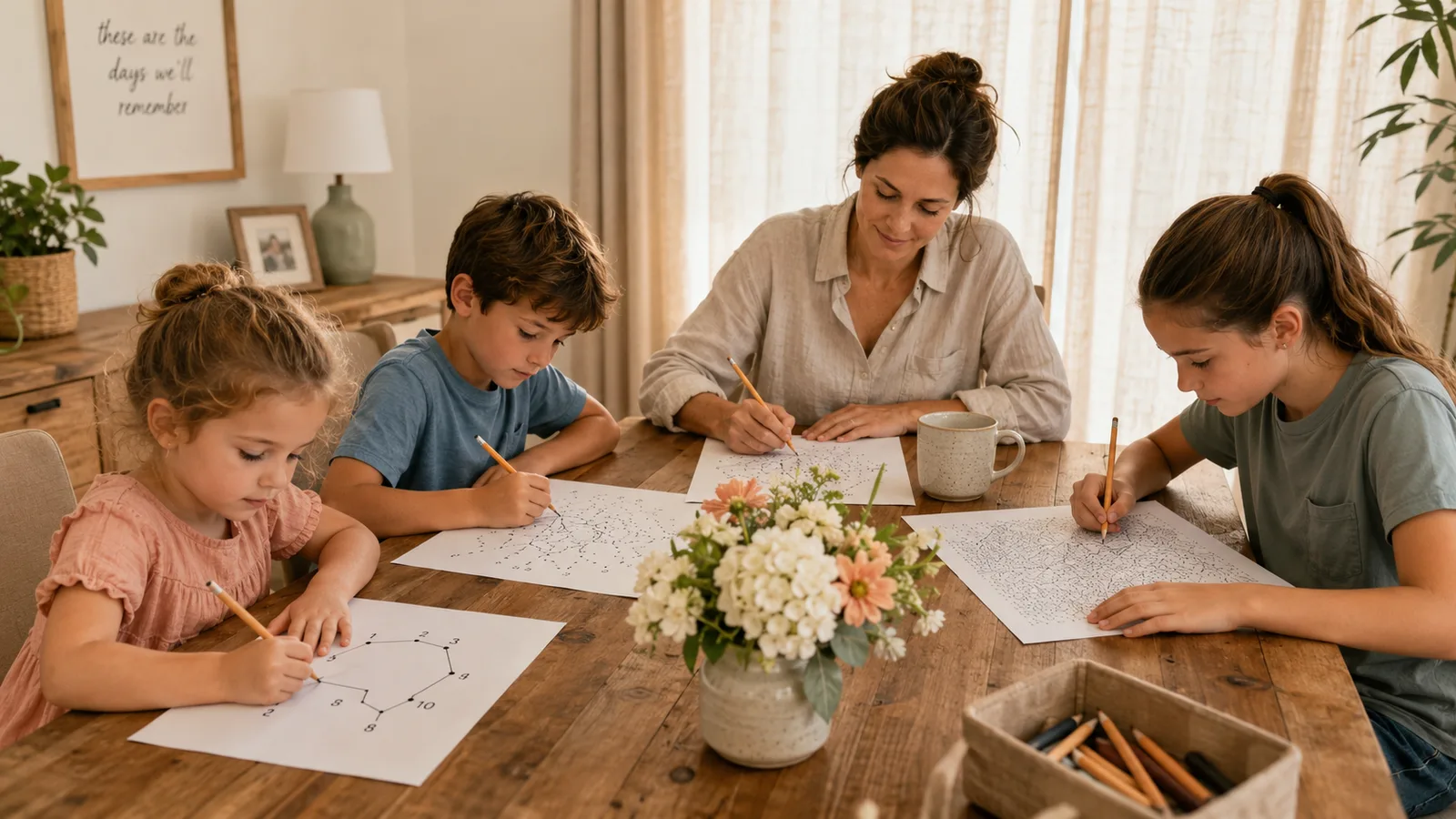
It's 4:15 on a Tuesday, week two of the school holidays, and the sound coming from your living room is technically still called "playing." It doesn't matter whether you're in Houston with the air conditioning humming since breakfast, in Dubai or Doha where stepping outside at 2pm feels like opening an oven door, or in Melbourne where the July break means rain, wind, and dark by five. The kids are inside. The volume climbs. And everyone in the house — including you — starts to fray.
This is about one small ritual that turns that hour around: a daily Quiet Hour, anchored by a stack of free printable dot to dot puzzles — the kind you'll find all over this site. It costs nothing, takes about five minutes to set up on a Sunday, and — here's the part that surprises most parents — kids often stop resisting it after a few days. Some start asking for it.
The Real Summer Problem Isn't Boredom — It's Overstimulation
Every holiday article promises to "beat boredom," as if boredom were the enemy. It isn't. Boredom is just the smoke alarm — the fire is overstimulation. Watch a child melting down at 4pm and you'll see it: that child isn't empty. That child is full.
Full of screen time that started earlier than you planned. Full of noise — siblings, TV in the background, the general hum of a household with nowhere to go. And missing the one thing school quietly provided all year: a predictable rhythm. Bell rings, activity changes, everyone knows what comes next. Then holidays arrive and the structure vanishes overnight, right when the weather traps everyone indoors.
Many child-development experts point out that kids tend to regulate their emotions better when their days have predictable anchor points. The American Academy of Pediatrics makes a related point about media use — it's not only how much screen time children get, but how it displaces calmer activities, that matters.
So the fix isn't more entertainment. Most holiday homes are drowning in entertainment. The fix is a pocket of less.
What a Quiet Hour Actually Is (and Why Kids Secretly Love It)
The Quiet Hour is exactly what it sounds like. One hour, same time every day, when the whole house goes low-volume. Screens off. Music off. Everyone — kids and adults — sits down with something quiet and absorbing. No one has to nap. No one has to be silent. It just has to be calm.
If a full hour sounds ambitious, start with twenty minutes. That's honest advice from plenty of parents who tried to launch straight into sixty and gave up by Wednesday. Twenty minutes that actually happen beat an hour that exists only on the fridge schedule.
Here's the counterintuitive bit: children like this more than they'll admit. Kids push against structure in the moment and rely on it underneath. A Quiet Hour gives the day a spine. It also gives them something school never did — you, sitting nearby, doing your own quiet thing instead of refereeing. Some of the best conversations happen in the last ten minutes of Quiet Hour, when a puzzle is nearly finished and a child suddenly feels like talking.
One warning so you can plan around it: day one is usually fine because it's novel. Day two is the mutiny. Hold the line on day two and you're most of the way there.
Why Dot to Dot Beats Almost Everything Else for Quiet Time
You could fill a Quiet Hour with anything — books, blocks, drawing. All good. But dot to dot puzzles have a particular mechanism that makes them the strongest anchor for quiet time.
A dot to dot puzzle is a treasure map where X marks dozens of tiny spots, in order. Find the number, draw the line, find the next number. Each step is small and winnable, so a child is never stuck. But the sequence demands just enough attention that the mind can't wander off to "I'm bored" or "can I have the iPad." Psychologists would call it a task with a clear goal and immediate feedback — the same ingredients that make adult coloring books and knitting so oddly soothing. It's mindfulness for people who refuse to sit still and breathe on command.
And there's a payoff a book can't offer. At the end, a picture appears. A dolphin, a rocket, a T-rex — revealed by the child's own hand. That small reveal is why kids will finish a dot to dot they would have abandoned as a coloring page. Finishing feels like winning.
One more practical advantage: paper doesn't have a next-episode button. When the puzzle ends, it ends. No algorithm is fighting you for your child's attention.
Setting It Up by Age: Three to Teens
The fastest way to kill the ritual is a wrong-level puzzle. Too easy and it's finished in four minutes; too hard and you get tears at dot 57. A rough guide:
Ages 3 to 5: Stick to our shortest puzzles (about 35–50 dots) with big, widely spaced numbers. At this age it's really counting practice wearing a disguise, and that's fine. Sit close for the first few days — preschoolers do best when Quiet Hour means quiet together, not alone. Expect fifteen to twenty minutes, not a full hour, and call that a success.
Ages 6 to 8: Medium puzzles, roughly 50 to 90 dots. This is the golden age for dot to dot: they can work independently, they're proud of the result, and the counting stretches them just enough. This group also cares most about displaying finished work, so keep the fridge magnets ready.
Ages 9 and up: Go challenging — our longest puzzles, which run past 100 dots and up to 145, with intricate pictures. Don't assume older kids are above this. Hand a 12-year-old one of the 100-plus-dot puzzles and you'll see the same absorbed silence adults get from a crossword. Teens will roll their eyes at "Quiet Hour" and then quietly finish the puzzle. Parents, print one for yourself too. Sitting there scrolling your phone while everyone else works on paper sends exactly the wrong message — and honestly, you've earned twenty minutes of not thinking about anything.
Mixed-age homes: same table, different difficulty. That's the whole trick.
A Five-Day Starter Plan You Can Copy Tonight
Give the first week a theme-a-day rhythm so there's something to look forward to:
- Day 1, Animals: The friendliest starting point. Puppies, lions, elephants, owls — instantly recognizable, which keeps early motivation high.
- Day 2, Vehicles: Cars, jets, gliders, dump trucks. This is your mutiny-day insurance; even reluctant joiners find it hard to walk away from a half-revealed dump truck.
- Day 3, Sea creatures: Dolphins, whales, an octopus with a satisfying number of arms — try our ocean dot to dot puzzles. Cooling to look at whether it's 43 degrees outside in the Gulf or sleeting in Sydney.
- Day 4, Dinosaurs: The reliable crowd-pleaser — this is where our dinosaur puzzles earn their keep. Pair it with a "guess the dinosaur before you finish" game for younger kids.
- Day 5, Space: Ringed planets, astronaut helmets, a crescent moon. A nice, quiet way to end the week — and a natural conversation starter about the night sky.
Small Tips That Make the Quiet Hour Stick
Rituals survive on friction removal, not enthusiasm. Four things that help:
- Same time, every day. After lunch works in most homes — it's the natural energy dip, and in hot climates it's the hour nobody should be outside anyway. Vague timing ("sometime this afternoon") is how the ritual dies.
- Batch-print on Sunday. A week of puzzles in one folder, sorted by child. Five minutes of prep buys seven days of calm.
- Let each child pick tomorrow's puzzle tonight. Choosing is half the fun, and a child who picked their own puzzle has already committed to it. This one change cuts most of the negotiating.
- Display the finished work. Fridge, hallway wall, a string with pegs — anywhere visible. By week three the fridge becomes the gallery of the kitchen, and a growing collection turns the Quiet Hour from a rule into a streak kids want to keep.
Start Yours This Week
None of this needs apps, subscriptions, or a trip to the shops. It's one of the few screen-free summer activities that runs on a printer and a pencil — and works exactly the same as an indoor activity for kids in a Doha August or a Melbourne July.
Pick a time. Print five puzzles. Announce the Quiet Hour at dinner tonight with more confidence than you feel — kids can smell a trial balloon.
Download a free batch of dot to dot printables for every age, put them in a folder by the kettle, and see what your house sounds like on day four. Odds are, it sounds like pencils.