Parent Guide
How to Choose the Right Dot to Dot Puzzle for Your Child: A 2026 Age Guide by Dot Count
A practical dot to dot age guide: how many dots for ages 2–12, what actually predicts success (hint: not the birthday), and how to adjust when a puzzle is too easy or too hard.
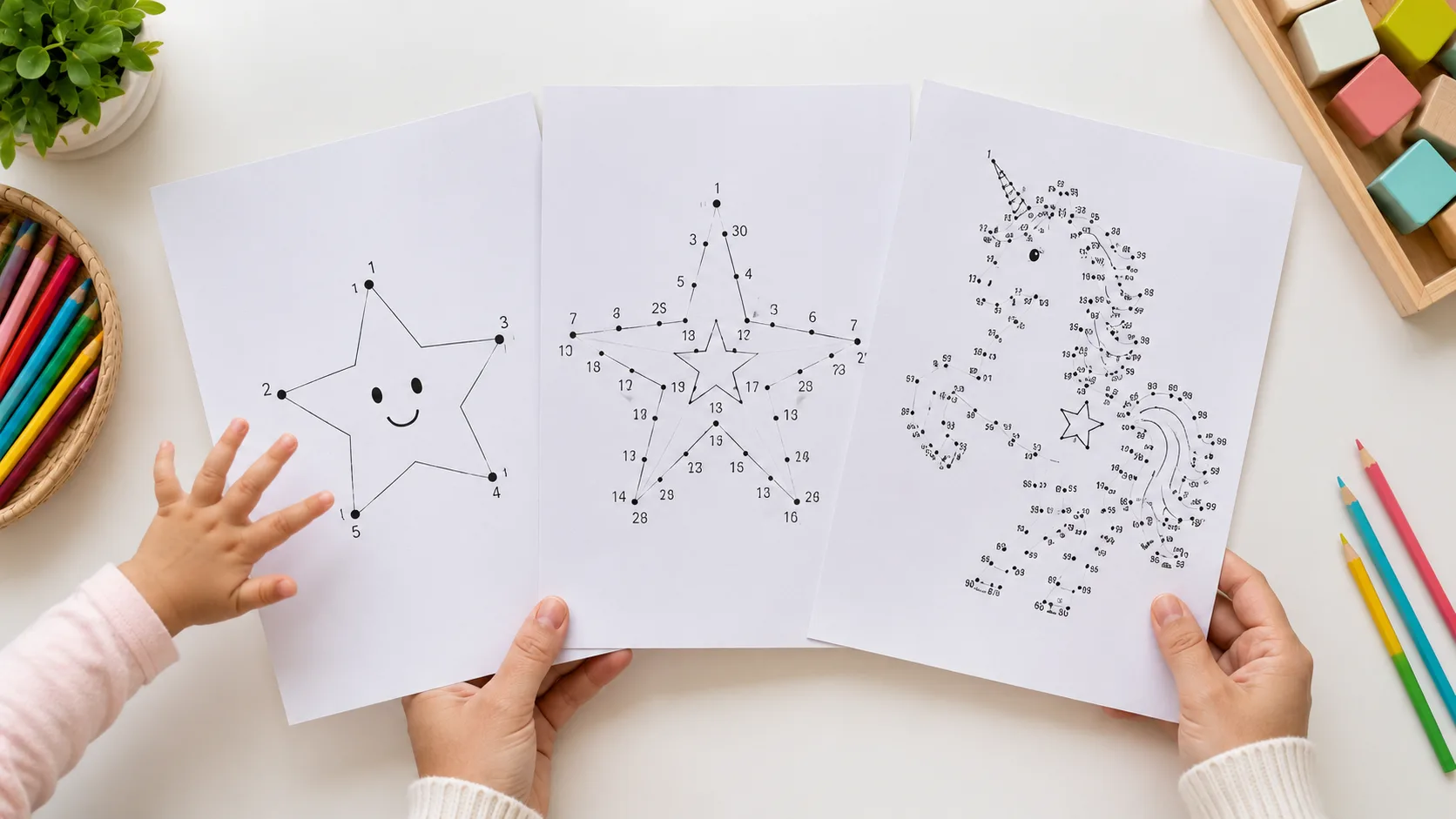
Short answer: ages 2–3 do best with 1–10 dots, ages 3–4 with 10–20, ages 4–6 with 20–50, ages 6–8 with 50–100, and ages 8 and up can handle 100 or more. That's the dot to dot age guide in one sentence — and for most families it's enough to pick a good first puzzle.
But age is only the starting point. The fastest way to put a child off dot to dot puzzles is to hand them the wrong one. Too easy, and it's finished in ninety seconds with zero attention paid. Too hard, and the page gets pushed away before the picture ever appears. The right puzzle sits just past the edge of comfortable — hard enough to require attention, easy enough to finish.
The good news: with dot to dot printables free to print, getting it wrong costs you one sheet of paper. Here's how to get it right faster.
The dot-count age guide
This ladder is a general guide, not a list of our puzzle sizes: our shortest puzzles start at about 35 dots, so for younger ages print the shortest puzzles and trace together. Treat the ages as trailheads, not rules.
- Ages 2–3 (toddler): 1–10 dots. Large, widely spaced dots and a shape that's obvious even half-finished. The win here is holding the pencil and finding "1."
- Ages 3–4 (preschool): 10–20 dots. Number recognition to 20 is the gate, not the birthday.
- Ages 4–6 (kindergarten–1st grade): 20–50 dots. Pictures get interesting enough to color afterward — which usually adds extra activity time.
- Ages 6–8 (1st–2nd grade): 50–100 dots. Curves and direction changes now matter as much as counting.
- Ages 8–12 and up: 100+ dots. These genuinely challenge older kids — and most adults who claim they're just helping.
Start with the child, not the age label
Age ranges on worksheets are rough averages, and children scatter widely around them. What actually predicts success is number knowledge: a four-year-old who confidently recognizes numerals to 20 is ready for a 20-dot puzzle, while a six-year-old still mixing up 12 and 21 will do better starting lower — and that's fine.
Two quick checks tell you most of what you need. Can the child name numbers out of order when you point at them (not just recite the sequence)? And can they draw a reasonably controlled line between two points? Those two skills, not the birthday, set the starting level.
How many dots should a 4-year-old connect?
Somewhere between 10 and 25, in most cases. A typical four-year-old is still building numeral recognition past 10, so a 15-dot puzzle with big, friendly spacing usually lands right. If they finish it and immediately ask for another, try 20–25. If they stall at dot 11 because they don't recognize the numeral yet, that's not a puzzle problem — count the dots out loud together and let them draw the lines.
The same logic scales to any age. Move up when a puzzle is finished quickly with attention to spare; move down when you hear frustration before the halfway point.
Theme buys you difficulty
A child who grumbles at 40 dots of abstract shape will fight through 40 dots of T. rex without complaint. When introducing a harder number range, pair it with whatever the child currently loves — dinosaurs, ocean animals, playgrounds — and let interest carry the extra effort.
This is also the cheapest fix when a child is stuck on a level. Don't drop the dot count; change the picture.
Watch the child, then adjust
The best difficulty signal isn't on the worksheet; it's on the child's face. A well-matched puzzle produces a particular look — leaning in, counting under the breath, a small grumble at the tricky cluster near dot 30, then pressing on. Constant requests for help mean the level is too high. Racing through without looking at the numbers means it's too low.
If a page is clearly too hard, stop before frustration sets in. Nothing is lost — put it aside and print one with fewer dots. Ending on a completed puzzle matters more than pushing through a difficult one, because the feeling the child walks away with decides whether they ask to do it again tomorrow.
And progress doesn't need to be a straight line. Alternating easy confidence-builders with harder stretch pages keeps the activity fun, which is the whole reason it works. A mix of both in the printing tray beats a rigid progression every time. If you want the deeper why — what these puzzles actually build — we've written up how dot to dot puzzles help children learn.
Print three levels — one easy, one at your best guess, one harder — and let the child's response tell you where they are. Ten minutes of watching beats any age label on the page.