Ocean
Jellyfish Dot to Dot — Free 88-Dot Printable for Ages 5–8
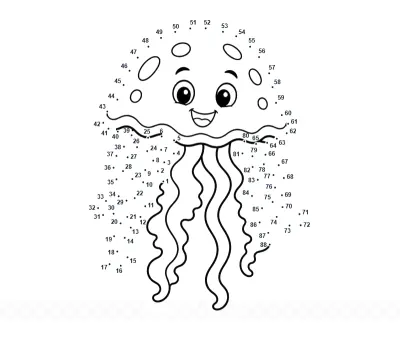
Connect 88 dots to reveal a graceful jellyfish drifting through the sea. This slightly bigger puzzle is a great step up for children aged 5-8 who are ready for extra dots and more detailed number sequencing practice.
Difficulty
Medium
Fun fact: Jellyfish have no brain, no heart, and no bones — yet they have survived for over 500 million years!
Downloaded63+timesYou’ve made a great choice!
Downloads now start from the button below. Tap it to get this puzzle's PDF.
Number Version
Connect the numbered dots from 1 to the end to reveal the picture.
Free for home and classroom use.
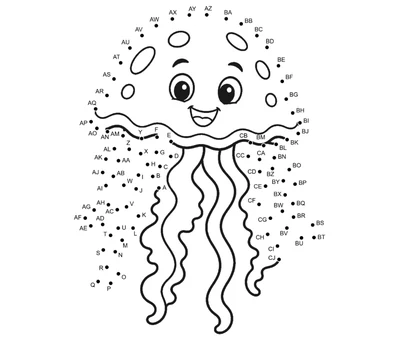
Alphabet Version
Includes alphabet-themed design for easy learning.
No sign-up needed. Opens as a PDF. Print on US Letter (8.5 × 11 inch) or A4 paper. Free for home and classroom use.
Ocean
You might also like
Ages 5–8 — Medium
How to Solve the Jellyfish Dot-to-Dot Puzzle
Jellyfish are among the strangest and most ancient animals in the ocean — they were drifting through the seas long before dinosaurs ever walked the earth. With no brain, no heart, and no blood, they are living proof that nature does not need complexity to succeed. This 88-dot puzzle is a satisfying step up for older children ready for a bigger challenge. Find dot 1 and let's start drifting!
1–18 — The Bell
Start at dot 1 and connect through to dot 18 to trace the rounded, dome-shaped bell — the jellyfish's main body. This is the largest section of the puzzle, and a great chance to practise smooth, wide curves without lifting the pencil. Encourage slow, steady strokes to keep the dome's shape nice and even.
Fun fact!
The jellyfish's bell is not just a body shape — it is also how the animal moves. By contracting and relaxing the bell like a pulsing umbrella, a jellyfish pushes water out behind it and propels itself forward. It is one of the oldest and simplest forms of movement in the animal kingdom, and it still works beautifully 500 million years later.
The jellyfish's bell is not just a body shape — it is also how the animal moves. By contracting and relaxing the bell like a pulsing umbrella, a jellyfish pushes water out behind it and propels itself forward. It is one of the oldest and simplest forms of movement in the animal kingdom, and it still works beautifully 500 million years later.
19–40 — The Fringe and Frills
Continue from dot 19 to dot 40 to draw the ruffled, frilly edge around the base of the bell. This section has lots of small curves close together, which is great practice for careful, patient dot-finding — a good challenge for children moving beyond the easiest puzzles.
Fun fact!
Some jellyfish species can produce their own light through a chemical reaction called bioluminescence. In the deep, dark ocean, a glowing jellyfish can look like a floating lantern — a beautiful way to either attract prey or startle a predator, depending on the species.
Some jellyfish species can produce their own light through a chemical reaction called bioluminescence. In the deep, dark ocean, a glowing jellyfish can look like a floating lantern — a beautiful way to either attract prey or startle a predator, depending on the species.
41–62 — The Trailing Tentacles
Trace dots 41 through 62 to draw the long, trailing tentacles that drift beneath the bell. These lines are longer and looser than the earlier sections, so encourage children to draw them with a relaxed hand, almost as if the pencil itself is floating in water.
Fun fact!
The tentacles of a box jellyfish carry some of the most powerful venom in the entire animal kingdom, used to instantly stun small fish and shrimp. Most jellyfish, however, are harmless to humans — only a small handful of species can deliver a sting that people need to worry about.
The tentacles of a box jellyfish carry some of the most powerful venom in the entire animal kingdom, used to instantly stun small fish and shrimp. Most jellyfish, however, are harmless to humans — only a small handful of species can deliver a sting that people need to worry about.
63–80 — The Oral Arms
Connect dots 63 to 80 to add the shorter, frillier oral arms near the centre of the jellyfish, which help guide food toward its mouth. This section rewards close attention, since the lines sit near each other. A slower pace here leads to the cleanest results.
Fun fact!
Jellyfish do not have a mouth and a separate exit — food goes in and waste comes out through the very same opening. It sounds unusual, but it works well for a jellyfish.
Jellyfish do not have a mouth and a separate exit — food goes in and waste comes out through the very same opening. It sounds unusual, but it works well for a jellyfish.
81–88 — The Final Trailing Threads
Finish the puzzle by connecting dots 81 through 88 to complete the last few drifting threads beneath the tentacles. Just eight dots to the finish line — a calm, gentle way to complete a bigger puzzle. Take a breath and let the final lines drift naturally into place.
Fun fact!
Jellyfish are found in every ocean on Earth, from the warm surface waters near the equator to the freezing depths near the poles. Some species have even been found more than 12,000 feet below the surface, drifting silently in complete darkness.
Jellyfish are found in every ocean on Earth, from the warm surface waters near the equator to the freezing depths near the poles. Some species have even been found more than 12,000 feet below the surface, drifting silently in complete darkness.
Wonderful work — your jellyfish is ready to drift! This puzzle pairs nicely with a conversation about how some of the oldest animals on Earth are also some of the simplest. Colour your jellyfish in translucent blues, purples, or pinks for a realistic glow, or go bold and bright — either way, it will look stunning. Ready for your next challenge? Browse more dot to dot printables 1-100 from the deep.
Coloring Guide
Jellyfish: Classic Real-Life Colors
Jellyfish are mostly clear with a faint blue or green tint, and these pale sea colours keep that soft, see-through quality.
| Dot Range | Part | Color | Why this color | |
|---|---|---|---|---|
| Numeric | Alphabet | |||
| 1–18 | A–R | The Bell | Crayola Sea Green | Many jellyfish are clear with a faint green or blue tint, so a pale sea-green bell is close to how they really look. |
| 19–40 | S–AN | The Fringe and Frills | Crayola Sky Blue | The ruffled edge of the bell is thin and see-through, and a light sky-blue lets it look almost transparent. |
| 41–62 | AO–BJ | The Trailing Tentacles | Crayola Cornflower | A soft blue suits the long tentacles, which are hard to see in water until they catch the light. |
| 63–80 | BK–CB | The Oral Arms | Crayola Sea Green | The frilly oral arms near the mouth take the same green as the bell, tying the centre of the animal together. |
| 81–88 | CC–CJ | The Final Trailing Threads | Crayola Sky Blue | The last drifting threads fade to pale blue, the way the thinnest parts of a jellyfish vanish into the water. |
Jellyfish: Soft Natural Colors
Silvers and whites treat the jellyfish like frosted glass, the way it looks when bright surface light shines straight through it.
| Dot Range | Part | Color | Why this color | |
|---|---|---|---|---|
| Numeric | Alphabet | |||
| 1–18 | A–R | The Bell | Crayola Silver | A jellyfish bell can look like frosted glass, and pale silver captures that near-colourless, sunlit shine. |
| 19–40 | S–AN | The Fringe and Frills | Crayola Gray | Soft grey keeps the frilled edge faint, as thin jelly tissue looks when light passes straight through it. |
| 41–62 | AO–BJ | The Trailing Tentacles | Crayola White | Near-white tentacles almost disappear, just as real ones are barely visible until they brush against something. |
| 63–80 | BK–CB | The Oral Arms | Crayola Silver | Silver on the oral arms keeps the busy centre of the jellyfish light and glassy. |
| 81–88 | CC–CJ | The Final Trailing Threads | Crayola Gray | The faint grey threads trail off like the last wisps of a jellyfish caught in bright water. |
Jellyfish: Bold Real-Life Colors
Some jellyfish really are deep orange or red, and this bold palette borrows those colours and the glow of a bioluminescent one.
| Dot Range | Part | Color | Why this color | |
|---|---|---|---|---|
| Numeric | Alphabet | |||
| 1–18 | A–R | The Bell | Crayola Orange | Some jellyfish, like the lion's mane, really are deep orange, so a bold orange bell is bright and true to those species. |
| 19–40 | S–AN | The Fringe and Frills | Crayola Red Orange | A strong red-orange picks out the frilly rim, the part that ripples as the bell pulses to push the animal along. |
| 41–62 | AO–BJ | The Trailing Tentacles | Crayola Brown | Deep brown gives the stinging tentacles a serious look, fitting for the few species whose sting really can hurt. |
| 63–80 | BK–CB | The Oral Arms | Crayola Orange | Bright orange makes the mouth arms easy to spot, the frilly parts that pass food into the jellyfish's single opening. |
| 81–88 | CC–CJ | The Final Trailing Threads | Crayola Red Orange | Red-orange threads glow at the end like a jellyfish lighting up with its own bioluminescence. |
Why Is the Jellyfish Dot to Dot Printable Rated Medium?
The Jellyfish is rated medium. Its 88 dots split into 36 straight, 19 curved, 25 zigzag and 8 sharp-turn dots — the direction changes are what lift it above an easy outline. The stretches to slow down for are final trailing threads at dots 83–87 and fringe and frills at dots 27–28. Follow the numbered order even when another dot looks nearer, and check the next number before each turn.
Straight
36 dots · 41%
Easiest — join two dots with one straight pencil stroke.
Curved
19 dots · 22%
73 75
Zigzag
25 dots · 28%
83 87
Sharp turns
8 dots · 9%
The hardest bits — tight corners where the line doubles back.
We traced all 88 dots on this exact worksheet by hand — the zigzag at dots 83–87 is where it got tricky, and you can check that against your own printout.
Key Sections to Know
Every notable stretch of the path, dot by dot.
| Dot Range | Pattern | Why It Matters | |
|---|---|---|---|
| Numeric | Alphabet | ||
| 27 28 | AA AB | Curved | A gentle curve shapes fringe and frills across dots 27–28. Spot dot 28 before you commit to the line. |
| 30 31 | AD AE | Curved | Follow fringe and frills as it curls from dot 30 to dot 31, easing the line rather than snapping it. |
| 42 43 | AP AQ | Curved | Around trailing tentacles, the line eases through a smooth bend at dots 42–43; keep the pencil moving slowly. |
| 61 62 | BI BJ | Curved | Dots 61–62 round off trailing tentacles — connect them one at a time so the arc stays even. |
| 73 75 | BU BW | Curved | The outline swings around oral arms here; take dots 73 to 75 in short strokes. |
| 83 87 | CE CI | Zigzag | A back-and-forth run shapes final trailing threads — work dot 83 through dot 87 in order and don't skip. |
Bottom line: The Jellyfish dot to dot is medium rated — 63% smooth lines with just 1 short section to watch for.