Flowers
Periwinkle Flower Dot to Dot — Free 72-Dot Printable for Ages 5–7
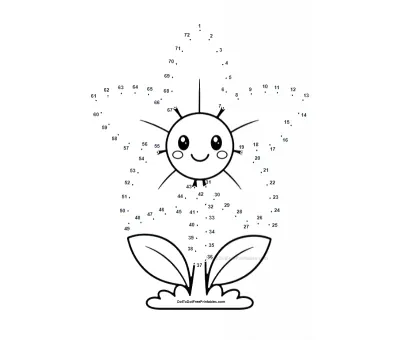
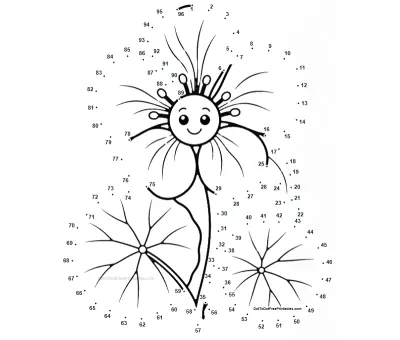
Connect 72 dots to reveal a charming periwinkle flower. This easy printable helps children practice number sequencing, pencil control, visual tracking, patience, and concentration.
Difficulty
Easy
Fun fact: Periwinkle flowers usually have five petals that overlap like the blades of a tiny pinwheel.
Free for home and classroom use.
No sign-up needed. Opens as a PDF. Print on US Letter (8.5 × 11 inch) or A4 paper. Free for home and classroom use.
Flowers
You might also like
Ages 5–7 — Easy

How to Solve the Periwinkle Flower Dot-to-Dot Puzzle
Periwinkle flowers have a neat little secret in their construction — their five petals overlap at an angle, spinning around the center like the blades of a tiny pinwheel, which is part of why the plant has stayed a garden favorite for centuries. This 72-dot puzzle opens that pinwheel bloom before following the stem down to its leaves, across five stages. Find dot 1 at the flower's center and watch the pinwheel take shape.
1–14 — The Flower Center
Connect dots 1 through 14 around the small center, using short, careful strokes. This compact opening section anchors the pinwheel shape that follows.
Fun fact!
The center of a periwinkle flower is often a contrasting color, which helps attract and guide pollinators toward its nectar.
The center of a periwinkle flower is often a contrasting color, which helps attract and guide pollinators toward its nectar.
15–29 — The Upper Petals
Continue from dot 15 to dot 29 to shape the upper petals. Angling each petal slightly rather than drawing it straight helps capture the flower's pinwheel twist.
Fun fact!
Periwinkle petals join together at their base, forming a narrow floral tube before spreading out into the five flat petals.
Periwinkle petals join together at their base, forming a narrow floral tube before spreading out into the five flat petals.
30–43 — The Lower Petals
Follow dots 30 through 43 to complete the five-petal bloom. Keep the same gentle twist as the upper petals so the whole flower reads as one balanced pinwheel.
Fun fact!
Periwinkle flowers may be blue, violet, pink, red, or white, depending on the variety.
Periwinkle flowers may be blue, violet, pink, red, or white, depending on the variety.
44–58 — The Trailing Stem
Trace dots 44 through 58 along the stem with steady pencil lines. Smooth, unhurried strokes suit periwinkle's naturally low, spreading growth habit.
Fun fact!
Many periwinkle plants spread using trailing stems that can root wherever they touch the soil, helping the plant form a dense ground cover.
Many periwinkle plants spread using trailing stems that can root wherever they touch the soil, helping the plant form a dense ground cover.
59–72 — The Glossy Leaves
Connect dots 59 through 72 to add the leaves and finish. Just fourteen dots remain — a smooth oval shape gives the leaves their glossy, polished look.
Fun fact!
Periwinkle leaves are smooth, oval, and glossy green, staying attractive on the plant throughout the year.
Periwinkle leaves are smooth, oval, and glossy green, staying attractive on the plant throughout the year.
Your periwinkle is complete! Color it blue, violet, pink, red, or white to match its many real-life varieties. Explore more free flower dot-to-dot printables to keep the fun going.
Coloring Guide
Classic Violet-Blue Periwinkle
Violet-blue is the most common wild periwinkle color, giving the flower and the color named after it their familiar shade.
- 1–14 (Flower center): Crayola Cornflower — A lighter blue eye often appears at the center of a periwinkle flower.
- 15–29 (Upper petals): Crayola Blue Violet — Violet-blue is the classic, most common periwinkle petal color.
- 30–43 (Lower petals): Crayola Blue Violet — The pinwheel-shaped petals usually share one even violet-blue tone.
- 44–58 (Trailing stem): Crayola Forest Green — Periwinkle is a low, trailing groundcover plant with slender green stems.
- 59–72 (Glossy leaves): Crayola Sea Green — Periwinkle leaves are glossy and evergreen, even through winter.
Alba White Periwinkle
'Alba' is a real, if less common, pure white periwinkle cultivar found alongside the more usual violet-blue form.
- 1–14 (Flower center): Crayola Dandelion — A small yellow-green eye can still show at the center of a white periwinkle.
- 15–29 (Upper petals): Crayola Silver (outline only) — The Alba cultivar produces clean white petals.
- 30–43 (Lower petals): Crayola Silver (outline only) — White petals keep the same pinwheel shape as the common form.
- 44–58 (Trailing stem): Crayola Forest Green — Stem color and trailing habit stay the same in every periwinkle form.
- 59–72 (Glossy leaves): Crayola Sea Green — Glossy leaves remain a feature of every periwinkle variety.
Blue Pearl Periwinkle
'Blue Pearl' is a real named variety with soft lavender-blue petals surrounding a bright white center eye.
- 1–14 (Flower center): Crayola Silver (outline only) — This variety is named for its clear white center eye.
- 15–29 (Upper petals): Crayola Cornflower — Blue Pearl petals are a softer, lighter blue than the classic wild form.
- 30–43 (Lower petals): Crayola Cornflower — A gentle lavender-blue covers the rest of the flower.
- 44–58 (Trailing stem): Crayola Forest Green — This variety keeps the same trailing green stems.
- 59–72 (Glossy leaves): Crayola Sea Green — Shiny, evergreen leaves complete this popular cultivar.
Why Is the Periwinkle Flower Dot to Dot Printable Rated Easy?
The Periwinkle Flower is rated easy. Of its 72 dots, 60 run in straight lines, with 0 curved, 1 zigzag, and 11 twisted dots. The line stays gentle from start to finish, so there isn't one stretch that needs extra care — just keep an even pace through the flower center, the upper and lower petals, the trailing stem, and the glossy leaves, and check each number before you draw.
Straight
60 dots · 83%
172
Zigzag
1 dots · 1%
Quick in-and-out changes of direction. Good counting practice.
Sharp turns
11 dots · 15%
The hardest bits — tight corners where the line doubles back.
We traced all 72 dots on this exact worksheet by hand to write this — not a generic guess.
Key Sections to Know
Every notable stretch of the path, dot by dot.
| Dot Range | Pattern | Why It Matters |
|---|---|---|
| 172 | Straight | Nearly every segment here is a short, evenly spaced straight line, from the flower center through the upper and lower petals, along the trailing stem, to the glossy leaves — a smooth, steady puzzle to solve start to end. |
Bottom line: The Periwinkle Flower dot to dot is easy rated — 83% smooth lines with no tricky spots to watch for.
Made by a young artist
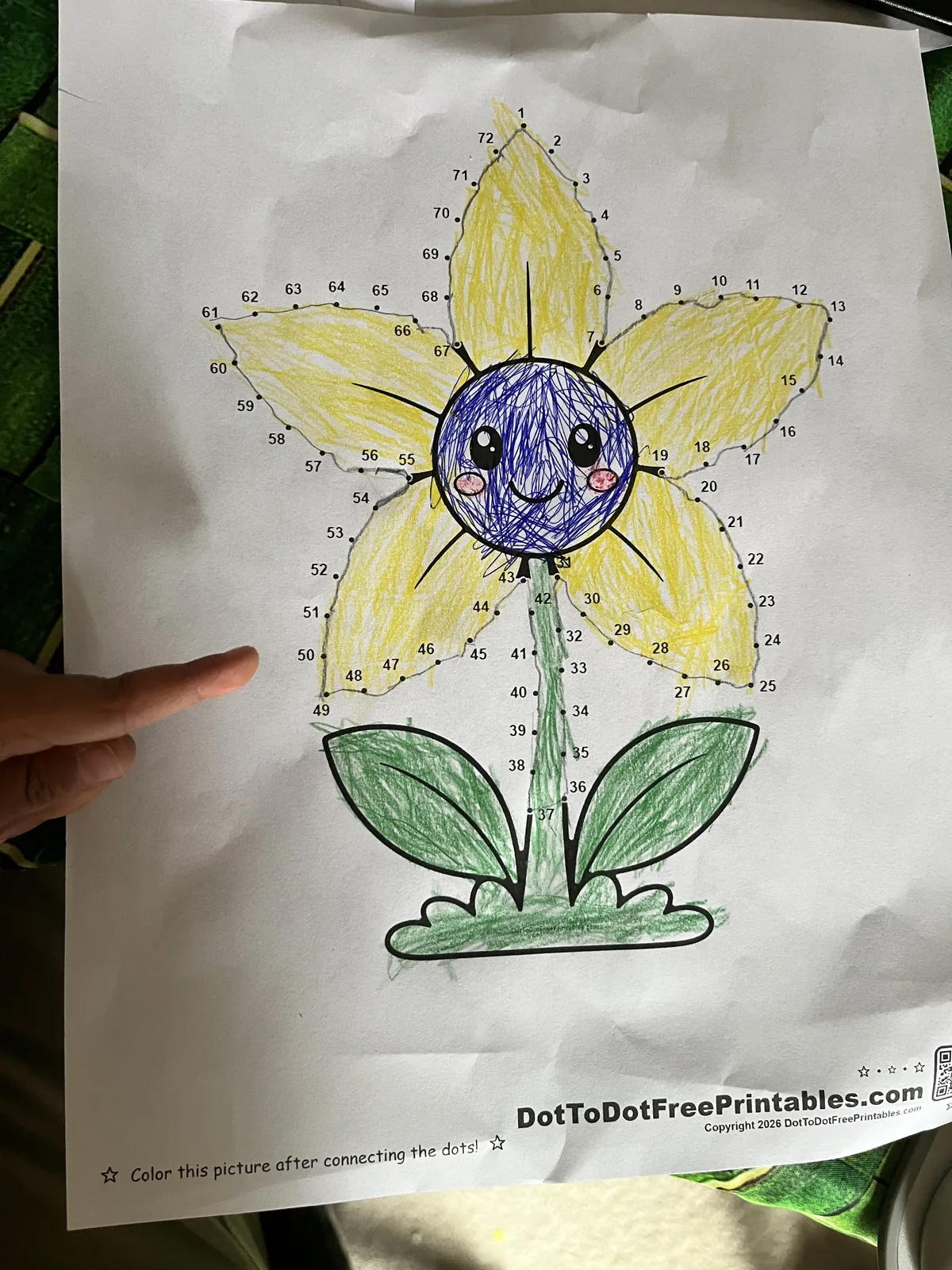
Example Completed Puzzle