Cute
Cute Puppy Dot to Dot — Free 70-Dot Printable for Ages 5–8
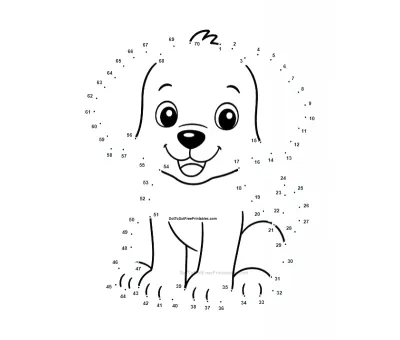
Connect 70 dots to reveal an adorable puppy. This medium printable puzzle helps children practise number sequencing, pencil control, and concentration.
Difficulty
Medium
Fun fact: Puppies are born unable to see or hear — their eyes and ears open at around two weeks old, and by three weeks they are already exploring the world.
Downloaded40+timesYou’ve made a great choice!
Free for home and classroom use.
No sign-up needed. Opens as a PDF. Print on US Letter (8.5 × 11 inch) or A4 paper. Free for home and classroom use.
Cute
You might also like
Ages 5–8 — Medium
How to Solve the Cute Puppy Dot-to-Dot Puzzle
Everybody loves a puppy! With its floppy ears, wagging tail, and big curious eyes, a puppy is one of the most rewarding animals a child can draw. This 70-dot puzzle builds the puppy up section by section, so grab a pencil, find a comfy spot, and let this little friend bound onto the page!
1–15 — The Head and Floppy Ears
Start at dot 1 and work through to dot 15 to draw the rounded head and soft, floppy ears. Ears are a wonderful first section because their gentle curves reward a slow, careful hand — encourage children to look ahead to the next dot before drawing each line.
Fun fact!
A dog's sense of hearing is around four times more sensitive than a human's. Floppy ears aren't just cute — many working breeds were bred with them to protect the ear canal from dirt and seeds while sniffing along the ground.
A dog's sense of hearing is around four times more sensitive than a human's. Floppy ears aren't just cute — many working breeds were bred with them to protect the ear canal from dirt and seeds while sniffing along the ground.
16–30 — The Face and Friendly Snout
Continue from dot 16 to dot 30 to shape the puppy's face, snout, and little nose. This is the most detailed part of the puzzle, with shorter lines packed closer together, so it's a great exercise in precision and patience.
Fun fact!
A dog's nose print is as unique as a human fingerprint — no two dogs have the same pattern of ridges and creases. Dogs can also smell somewhere between 10,000 and 100,000 times better than people can.
A dog's nose print is as unique as a human fingerprint — no two dogs have the same pattern of ridges and creases. Dogs can also smell somewhere between 10,000 and 100,000 times better than people can.
31–45 — The Body
Trace dots 31 through 45 to draw the puppy's round, huggable body. The strokes here are longer and smoother than in the face section — a nice change of rhythm that helps children practise confident, flowing lines.
Fun fact!
Puppies sleep between 15 and 20 hours a day! All that sleep isn't laziness — it's when their brains and bodies do most of their growing, just like human babies.
Puppies sleep between 15 and 20 hours a day! All that sleep isn't laziness — it's when their brains and bodies do most of their growing, just like human babies.
46–58 — The Legs and Paws
Connect dots 46 to 58 to add the sturdy little legs and soft paws. Paws have small, rounded shapes that take a bit of care, so remind children there's no rush — steady lines make the best paws.
Fun fact!
Dogs technically walk on their toes, not the soles of their feet. The soft pads underneath act like built-in cushions, absorbing shock and protecting their feet on rough ground.
Dogs technically walk on their toes, not the soles of their feet. The soft pads underneath act like built-in cushions, absorbing shock and protecting their feet on rough ground.
59–70 — The Wagging Tail
Finish by connecting dots 59 through 70 to draw the happy, wagging tail. Just twelve dots to go — a smooth, confident finish here brings the whole puppy to life. Don't forget to add a smile when you're done!
Fun fact!
A wagging tail doesn't always mean a happy dog — scientists have found that dogs tend to wag more to the right when they feel relaxed and friendly, and more to the left when they feel unsure.
A wagging tail doesn't always mean a happy dog — scientists have found that dogs tend to wag more to the right when they feel relaxed and friendly, and more to the left when they feel unsure.
Brilliant work on a 70-dot challenge! Your puppy is ready for a name, a collar, and plenty of colouring. Why not draw a ball or a bone next to your new friend? Explore more circus dot to dot puzzles to keep the fun going.
Coloring Guide
Golden Retriever Puppy
Golden retrievers are one of the most popular dog breeds, known for their warm, golden coat and gentle nature.
- 1–15 (Head and floppy ears): Crayola Raw Sienna — Golden retriever ears are often a shade darker than the rest of the coat, like feathered fur.
- 16–30 (Face and friendly snout): Crayola Tan — The face is a warm golden tan, with a small black nose at the tip.
- 31–45 (Body): Crayola Tan — A golden retriever's coat is thick, wavy, and golden all over.
- 46–58 (Legs and paws): Crayola Tan — Feathery fur often grows a little longer on the legs, in the same golden tone.
- 59–70 (Wagging tail): Crayola Raw Sienna — The tail carries long, darker feathered fur, just like the ears.
Black and White Puppy
Black and white is a real, common coat pattern seen in breeds like the border collie, with bold patches instead of one solid colour.
- 1–15 (Head and floppy ears): Crayola Black — Many black and white breeds have solid black ears framing a lighter face.
- 16–30 (Face and friendly snout): Crayola Silver (outline only) — A white blaze down the face is a classic marking in patched breeds.
- 31–45 (Body): Crayola Black — A bold black body is typical of breeds like the border collie.
- 46–58 (Legs and paws): Crayola Silver (outline only) — White "socks" on the paws are a common marking in patched dogs.
- 59–70 (Wagging tail): Crayola Black — The tail usually matches the body, often with a white tip.
Why Is the Cute Puppy Dot to Dot Printable Rated Medium?
The Cute Puppy is rated medium. Its 70 dots split into 23 straight, 22 curved, 18 zigzag and 7 sharp-turn dots — the direction changes are what lift it above an easy outline. The stretches to slow down for are face and friendly snout at dots 29–32 and head and floppy ears at dots 9–10. Follow the numbered order even when another dot looks nearer, and check the next number before each turn.
Straight
23 dots · 33%
Easiest — join two dots with one straight pencil stroke.
Curved
22 dots · 31%
910
Zigzag
18 dots · 26%
2932
Sharp turns
7 dots · 10%
The hardest bits — tight corners where the line doubles back.
We traced all 70 dots on this exact worksheet by hand — the zigzag at dots 29–32 is where it got tricky, and you can check that against your own printout.
Key Sections to Know
Every notable stretch of the path, dot by dot.
| Dot Range | Pattern | Why It Matters |
|---|---|---|
| 910 | Curved | Around head and floppy ears, the line eases through a smooth bend at dots 9–10; keep the pencil moving slowly. |
| 1314 | Curved | Dots 13–14 round off head and floppy ears — connect them one at a time so the arc stays even. |
| 2932 | Zigzag | Dots 29–32 zigzag across face and friendly snout; the direction flips each dot, so join one pair at a time. |
| 3334 | Curved | A gentle curve shapes body across dots 33–34. Spot dot 34 before you commit to the line. |
| 4546 | Curved | Follow body as it curls from dot 45 to dot 46, easing the line rather than snapping it. |
| 4950 | Curved | Around legs and paws, the line eases through a smooth bend at dots 49–50; keep the pencil moving slowly. |
Bottom line: The Cute Puppy dot to dot is medium rated — 64% smooth lines with just 1 short section to watch for.