Space
Space Rover Dot to Dot — 59 Dots, Ready for Exploration
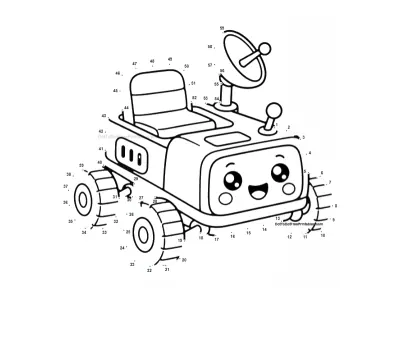
Connect 59 dots to reveal a friendly space rover ready to explore another world. This free printable puzzle helps children practise number order, concentration, and pencil control.
Difficulty
Easy
Fun fact: Space rovers are robotic vehicles that explore the surfaces of worlds such as the Moon and Mars.
Downloaded8+timesYou’ve made a great choice!
Downloads now start from the button below. Tap it to get this puzzle's PDF.
Free for home and classroom use.
No sign-up needed. Opens as a PDF. Print on US Letter (8.5 × 11 inch) or A4 paper. Free for home and classroom use.
Space
You might also like
Ages 4–8 — Easy
How to Solve the Space Rover Dot-to-Dot Puzzle
Exploring another world often means sending a rover instead of a person — a rugged robotic vehicle built to roll across rocky, dusty ground and send its discoveries back to scientists millions of kilometres away on Earth. This puzzle connects 59 dots to build a friendly space rover, from its sturdy body to its communication dish, across five stages. Find dot 1 at the rover's front and follow the trail all the way to dot 59.
1–12 — The Rover Body
Begin at dot 1 and connect through dot 12 to trace the rover's friendly front and sturdy body. This opening stretch sets the shape for the sturdy frame that carries everything else.
Fun fact!
Planetary rovers carry computers, cameras, and scientific instruments all packed inside one tough, protective body.
Planetary rovers carry computers, cameras, and scientific instruments all packed inside one tough, protective body.
13–25 — The First Wheels
Continue from dot 13 to dot 25 to shape the lower body and the first rugged wheel. Keep the wheel nicely rounded, since real rover wheels are built to handle rough, rocky ground.
Fun fact!
Rover wheels are specially designed to grip loose sand and roll over rocks without getting stuck, even on rough ground.
Rover wheels are specially designed to grip loose sand and roll over rocks without getting stuck, even on rough ground.
26–38 — The Wheel System
Connect dots 26 through 38 to complete more of the rover's wheels and suspension. This busier section has several wheels close together, so check each number carefully.
Fun fact!
NASA's Mars rovers use a rocker-bogie suspension system that lets all six wheels stay in contact with the ground, even when crossing wildly uneven terrain.
NASA's Mars rovers use a rocker-bogie suspension system that lets all six wheels stay in contact with the ground, even when crossing wildly uneven terrain.
39–49 — The Seat and Equipment
Trace dots 39 to 49 to add the seat and equipment above the rover body. Careful lines here keep the equipment looking neatly mounted rather than floating.
Fun fact!
Some lunar rovers were built to carry astronauts, while robotic rovers explore entirely on their own, with no one sitting inside at all.
Some lunar rovers were built to carry astronauts, while robotic rovers explore entirely on their own, with no one sitting inside at all.
50–59 — The Dish Antenna
Finish by joining dots 50 through 59 to complete the communication dish. Just ten dots remain — a careful curve gives the dish its rounded, satellite-like shape.
Fun fact!
A rover uses its antenna to send new discoveries back to Earth and to receive fresh instructions from mission control, sometimes taking many minutes for a signal to travel the distance.
A rover uses its antenna to send new discoveries back to Earth and to receive fresh instructions from mission control, sometimes taking many minutes for a signal to travel the distance.
Mission complete — your space rover is ready to explore! Add stars, craters, distant planets, or a friendly alien to create your very own space scene. Discover more dot to dot printables for every age.
Coloring Guide
Space Rover: Classic Real-Life Colors
The everyday colours of a real rover — bare metal panels, dark wheels and shadowed gaps, and a bright dish up top.
- 1–12 (The Rover Body): Crayola Silver — A rover's body is a boxy metal shell that guards its computers and cameras, and it looks bare silver where the sunlight strikes it.
- 13–25 (The First Wheels): Crayola Black — Rover wheels are built from dark, tough metal that grips loose sand and rolls over rocks, so they read almost black.
- 26–38 (The Wheel System): Crayola Black — The suspension arms and the gaps between the six wheels sit in deep shadow, reading almost black beneath the body.
- 39–49 (The Seat and Equipment): Crayola Silver — The instruments and mounts above the body share the same bare-metal look as the frame that carries them.
- 50–59 (The Dish Antenna): Crayola Scarlet — A rover's dish antenna often has a bright cap at its centre, easy to spot as it points back home to Earth.
Space Rover: Soft Natural Colors
A pale, dusty version — the rover after months on a bright, sun-blasted surface, coated all over in light-toned dust.
- 1–12 (The Rover Body): Crayola White — Fine pale dust settles over everything on a rover, leaving the body looking chalky white in full sun.
- 13–25 (The First Wheels): Crayola Cornflower — In flat daylight the rounded metal wheels pick up a cool bluish sheen from the sky above.
- 26–38 (The Wheel System): Crayola Gray — Under bright overhead light the shadowed suspension softens from black to a dusty mid-grey.
- 39–49 (The Seat and Equipment): Crayola White — Sun-bleached and dust-covered, the gear on top blends into the same pale tone as the body.
- 50–59 (The Dish Antenna): Crayola Cornflower — Tilted up toward the sky, the dish catches the pale blue of daylight across its curved face.
Space Rover: Bold Real-Life Colors
A bold, warm palette borrowed from the ground a rover explores — the rusty oranges and dark iron tones of a dusty planet like Mars.
- 1–12 (The Rover Body): Crayola Orange — Rusty dust from a world like Mars clings to a rover's panels, tinting the whole body a warm orange over time.
- 13–25 (The First Wheels): Crayola Goldenrod — The wheels throw up golden soil with every turn, so their rims soon wear a dusty yellow coat.
- 26–38 (The Wheel System): Crayola Mahogany — Packed red-brown grit builds up in the joints and gaps of the wheel system, the colour of iron-rich rock.
- 39–49 (The Seat and Equipment): Crayola Orange — The same planet dust drifts onto the instruments above, giving their mounts a warm rust tone.
- 50–59 (The Dish Antenna): Crayola Goldenrod — Angled up out of the worst of the dust, the dish keeps a brighter golden shine than the rest of the rover.