Space
Saturn Dot to Dot — 43 Easy Dots to Connect
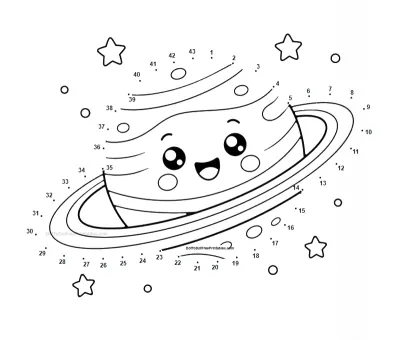
Connect 43 dots to complete Saturn and its sweeping rings. This easy printable helps younger children practise number order, visual tracking, concentration, and pencil control.
Difficulty
Easy
Fun fact: Saturn's rings are made of billions of pieces of ice, dust, and rock, ranging from tiny grains to much larger chunks.
Downloaded0+timesYou’ve made a great choice!
Downloads now start from the button below. Tap it to get this puzzle's PDF.
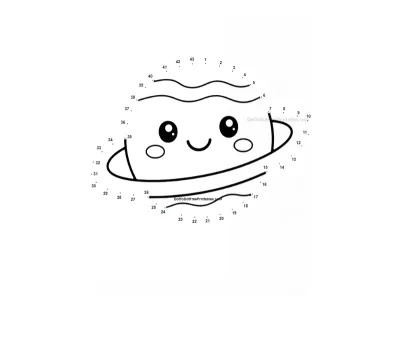
Number Version
Connect the numbered dots from 1 to the end to reveal the picture.
Free for home and classroom use.
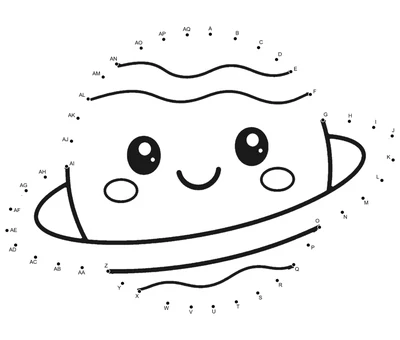
Alphabet Version
Includes alphabet-themed design for easy learning.
No sign-up needed. Opens as a PDF. Print on US Letter (8.5 × 11 inch) or A4 paper. Free for home and classroom use.
Space
You might also like
Ages 5–7 — Easy
How to Solve the Saturn Dot-to-Dot Puzzle
Saturn is the second-largest planet in our solar system, but what truly sets it apart is its dazzling ring system — a feature so wide it spans roughly three-quarters of the distance from Earth to the Moon. This 43-dot puzzle traces Saturn's rounded body and its famous rings across four stages. Find dot 1 at the top of the planet and follow the trail all the way to a finished ringed world at dot 43.
1–11 — Saturn's Upper Curve
Connect dots 1 through 11 to begin the round top of Saturn. A smooth, even curve here gives the planet its classic rounded silhouette.
Fun fact!
Saturn is a gas giant and the second-largest planet in our solar system, beaten in size only by Jupiter.
Saturn is a gas giant and the second-largest planet in our solar system, beaten in size only by Jupiter.
12–22 — The First Ring
Continue from dot 12 to dot 22 along the first long curve of the ring system. Keep the arc wide and sweeping, since Saturn's rings extend much further than the planet itself.
Fun fact!
Saturn's rings stretch far out from the planet but are surprisingly thin, made up of countless icy particles ranging from tiny grains to boulders.
Saturn's rings stretch far out from the planet but are surprisingly thin, made up of countless icy particles ranging from tiny grains to boulders.
23–33 — The Lower Planet
Follow dots 23 through 33 to complete Saturn's lower curve. This section balances the top of the planet, so aim to match the same roundness.
Fun fact!
Saturn is made mostly of hydrogen and helium, the two lightest elements — light enough that Saturn would actually float if you could find an ocean big enough to hold it.
Saturn is made mostly of hydrogen and helium, the two lightest elements — light enough that Saturn would actually float if you could find an ocean big enough to hold it.
34–43 — The Rings and Finish
Join dots 34 through 43 to finish the rings and complete the picture. Ten dots remain — a steady final arc brings the whole ring system together.
Fun fact!
The ring system contains many narrow ringlets separated by gaps, some of which are kept clear by the gravity of small moons orbiting within the rings.
The ring system contains many narrow ringlets separated by gaps, some of which are kept clear by the gravity of small moons orbiting within the rings.
Excellent work — Saturn is complete! Explore more space dot to dot puzzles to keep the fun going.
Coloring Guide
Saturn's Natural Golden Colors
Use pale gold, cream, tan, and soft gray to echo Saturn's cloudy atmosphere and icy rings.
| Dot Range | Part | Color | Why this color | |
|---|---|---|---|---|
| Numeric | Alphabet | |||
| 1–11 | A–K | Saturn's upper curve | Crayola Golden Yellow | Saturn often appears pale gold because of haze in its upper atmosphere. |
| 12–22 | L–V | First ring | Crayola Almond | A light cream suggests the bright ice particles found throughout the rings. |
| 23–33 | W–AG | Lower planet | Crayola Tan | Soft tan bands add gentle contrast to Saturn's golden clouds. |
| 34–43 | AH–AQ | Rings and finish | Crayola Silver | Silver-gray shading helps separate the many icy bands in the rings. |
Why Is the Saturn Dot to Dot Printable Rated Easy?
The Saturn is rated easy. Of its 43 dots, 33 run in straight lines, with 5 curved, 5 zigzag and 0 sharp-turn dots. The stretch to slow down for is lower planet at dots 31–32. Follow the numbered order even when another dot looks nearer, and check the next number before each curve.
Straight
33 dots · 77%
Easiest — join two dots with one straight pencil stroke.
Curved
5 dots · 12%
31 32
Zigzag
5 dots · 12%
Quick in-and-out changes of direction. Good counting practice.
We traced all 43 dots on this exact worksheet by hand to write this — not a generic guess.
Key Sections to Know
Every notable stretch of the path, dot by dot.
| Dot Range | Pattern | Why It Matters | |
|---|---|---|---|
| Numeric | Alphabet | ||
| 31 32 | AE AF | Curved | A gentle curve shapes lower planet across dots 31–32. Spot dot 32 before you commit to the line. |
Bottom line: The Saturn dot to dot is easy rated — 88% smooth lines with no tricky spots to watch for.