Dinosaurs
Brontosaurus Dot to Dot — Free 50-Dot Printable for Ages 5–7
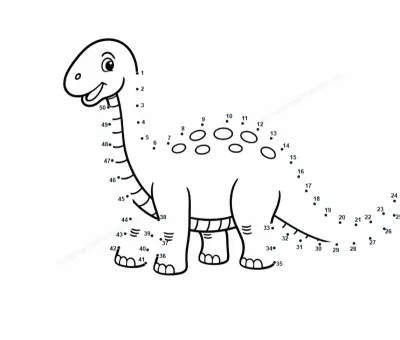
Connect 50 easy dots to reveal a cheerful Brontosaurus with a long neck and sweeping tail. This free printable dot-to-dot worksheet for kids helps preschool and early elementary children practise number sequencing, pencil control, and concentration.
Difficulty
Easy
Fun fact: "Brontosaurus" means thunder lizard, a name inspired by its enormous size!
Downloaded30+timesYou’ve made a great choice!
Downloads now start from the button below. Tap it to get this puzzle's PDF.
Free for home and classroom use.
No sign-up needed. Opens as a PDF. Print on US Letter (8.5 × 11 inch) or A4 paper. Free for home and classroom use.
Dinosaurs
You might also like
Ages 5–7 — Easy
How to Solve the Brontosaurus Dot-to-Dot Puzzle
Welcome to one of the most loveable dinosaur puzzles in the whole collection! The Brontosaurus — whose name means "thunder lizard" — was one of the biggest creatures ever to walk our planet. Grab a pencil, find dot number one, and let's bring this gentle giant back to life, one line at a time!
1–8 — The Head
Start at dot 1 and connect through to dot 8 to trace the Brontosaurus's surprisingly small, wedge-shaped head. Children practise short, careful pencil strokes and gentle curved lines here — a lovely way to build early pencil control before tackling bigger shapes.
Fun fact!
Brontosaurus had peg-like teeth designed only for stripping leaves off branches, not for chewing. It swallowed plants whole and let its massive stomach do the hard work — a pretty clever system, really!
Brontosaurus had peg-like teeth designed only for stripping leaves off branches, not for chewing. It swallowed plants whole and let its massive stomach do the hard work — a pretty clever system, really!
9–18 — The Long Neck
Now here comes the showstopper. Connect dots 9 through 18 to draw that famously long, sweeping neck that curves gracefully upward. This is a brilliant section for practising smooth, flowing lines — children discover that longer curves need more patience and a steadier hand.
Fun fact!
The Brontosaurus's neck stretched up to 20 feet long — roughly the height of a two-storey house! Scientists now believe it grazed mainly at low to mid-level plants rather than craning up into treetops the way a giraffe does.
The Brontosaurus's neck stretched up to 20 feet long — roughly the height of a two-storey house! Scientists now believe it grazed mainly at low to mid-level plants rather than craning up into treetops the way a giraffe does.
19–32 — The Body
Continue from dot 19 all the way to dot 32 to fill out the Brontosaurus's massive, barrel-shaped torso. This longest section of the puzzle is great for building concentration and stamina — children learn to keep going even when the task feels big.
Fun fact!
Brontosaurus weighed somewhere between 15 and 17 tonnes — about as heavy as two to three African elephants standing together. Despite that extraordinary size, it was entirely a plant-eater, completely harmless, and probably just wanted a quiet life among the ferns.
Brontosaurus weighed somewhere between 15 and 17 tonnes — about as heavy as two to three African elephants standing together. Despite that extraordinary size, it was entirely a plant-eater, completely harmless, and probably just wanted a quiet life among the ferns.
33–42 — The Legs
Trace dots 33 to 42 to form the four thick, column-like legs. Children begin to notice symmetry and how an animal's body is balanced from side to side. Drawing parallel shapes is a real skill, and this section gives little hands plenty of practice.
Fun fact!
Brontosaurus walked on the tips of its toes, with a cushioned pad behind — a bit like a ballerina on four feet! Beneath each foot was a thick, fleshy pad that acted like a natural cushion, softening every thunderous step across the Jurassic landscape.
Brontosaurus walked on the tips of its toes, with a cushioned pad behind — a bit like a ballerina on four feet! Beneath each foot was a thick, fleshy pad that acted like a natural cushion, softening every thunderous step across the Jurassic landscape.
43–50 — The Tail
Finish the puzzle by connecting dots 43 through 50 to draw the long, tapering tail sweeping out behind the dinosaur. The tail balanced the heavy neck and gave the Brontosaurus its graceful, almost boat-like silhouette. Children practise gradually narrowing their line — a satisfying way to end.
Fun fact!
Some scientists think Brontosaurus could crack its tail like a whip, with a sound as loud as a thunderclap! Not bad for a gentle giant that spent most of its day munching on plants.
Some scientists think Brontosaurus could crack its tail like a whip, with a sound as loud as a thunderclap! Not bad for a gentle giant that spent most of its day munching on plants.
Well done — you've just drawn a real Brontosaurus! That's 50 dots, five body parts, and one whole lot of prehistoric fun. Now grab the crayons and give your thunder lizard a colour scheme all of its own. Want more? Explore more dinosaur dot to dot printables to keep the fun going.
Coloring Guide
Brontosaurus: Classic Real-Life Colors
Dinosaur books usually give big plant-eaters like Brontosaurus a plain green-and-brown coat, dull colours that would keep a slow, house-sized animal from standing out among the ferns.
- 1–8 (The Head): Crayola Olive Green — Olive green on the small wedge-shaped head keeps it modest, as most illustrations do, since the mouth held only peg teeth for raking leaves off branches.
- 9–18 (The Long Neck): Crayola Forest Green — Forest green sweeps the twenty-foot neck in the mid-tone reconstructions favour for a neck that grazed low and level rather than up in the treetops.
- 19–32 (The Body): Crayola Brown — Brown fills the barrel-shaped torso, the shaded belly colour artists give a fifteen-tonne body that spent all day digesting swallowed plants.
- 33–42 (The Legs): Crayola Olive Green — Olive green on the four column-like legs matches the body, drawing attention instead to how evenly they carry that huge weight.
- 43–50 (The Tail): Crayola Forest Green — Forest green tapers down the long tail that balanced the neck and, at its thin tip, could crack like a whip.
Brontosaurus: Soft Natural Colors
Picture a Brontosaurus in bright Jurassic sun and its huge flank would look bleached and dusty, like the pale hide of an elephant in the midday heat.
- 1–8 (The Head): Crayola Gray — Pale grey shows the little head washed out in strong light, the peg teeth barely visible along the jaw.
- 9–18 (The Long Neck): Crayola Silver — Silver-grey runs the long neck the way a sun-faded hide catches the light all down its curve.
- 19–32 (The Body): Crayola Tan — Warm tan on the vast body suggests dust-coated skin along the flank where the sun sits longest.
- 33–42 (The Legs): Crayola Gray — Grey on the pillar legs is how thick, weathered skin reads at noon, each foot cushioned by a hidden fleshy pad.
- 43–50 (The Tail): Crayola Silver — Silver-grey along the tail keeps the pale, bleached look all the way to the tip.
Brontosaurus: Bold Real-Life Colors
Some artists paint sauropods with bold stripes and warm earth tones, guessing that even giants might have used pattern to recognise their own herd.
- 1–8 (The Head): Crayola Raw Sienna — Raw sienna gives the head a rusty tone, a bright spot at the end of a very long neck for herd-mates to follow.
- 9–18 (The Long Neck): Crayola Mahogany — Deep mahogany down the neck reads as a bold stripe stretching the height of a two-storey house.
- 19–32 (The Body): Crayola Goldenrod — Goldenrod across the body flashes a lighter belly band beneath the darker back, a common pattern in big animals.
- 33–42 (The Legs): Crayola Raw Sienna — Raw sienna on the legs makes the weight-bearing columns the warmest, strongest colour on the drawing.
- 43–50 (The Tail): Crayola Mahogany — Mahogany along the tail carries the bold stripe out to the whip-cracking tip.
Why Is the Brontosaurus Dot to Dot Printable Rated Easy?
The Brontosaurus is rated easy. Of its 50 dots, 38 run in straight lines, with 4 curved, 1 zigzag and 7 sharp-turn dots. The stretches to slow down for are legs at dots 35–36 and head at dots 5–6. Follow the numbered order even when another dot looks nearer, and check the next number before each turn.
Straight
38 dots · 76%
Easiest — join two dots with one straight pencil stroke.
Curved
4 dots · 8%
5 6
Zigzag
1 dots · 2%
Quick in-and-out changes of direction. Good counting practice.
Sharp turns
7 dots · 14%
35 36
We traced all 50 dots on this exact worksheet by hand — the sharp turns at dots 35–36 is where it got tricky, and you can check that against your own printout.
Key Sections to Know
Every notable stretch of the path, dot by dot.
| Dot Range | Pattern | Why It Matters |
|---|---|---|
| 5 6 | Curved | Around head, the line eases through a smooth bend at dots 5–6; keep the pencil moving slowly. |
| 35 36 | Sharp turns | There is a tight angle at legs here; treat dots 35 and 36 as two separate short lines. |
| 41 42 | Sharp turns | The line changes direction hard at dots 41–42, on legs — stop at 41, find 42, then turn. |
Bottom line: The Brontosaurus dot to dot is easy rated — 84% smooth lines with just 2 short sections to watch for.