Dinosaurs
Ostrich Dot to Dot: 55 Dots for the Fastest Bird
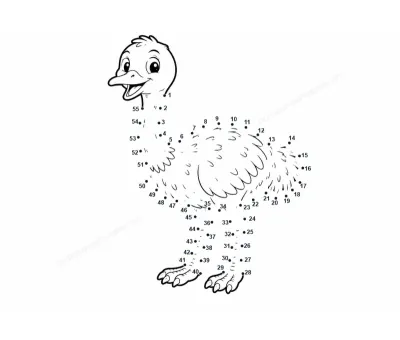
Connect 55 easy dots to reveal the magnificent Ostrich — the largest living bird on Earth! Ostriches can't fly but they can sprint as fast as many horses. This printable worksheet helps early elementary children practise number sequencing and pencil control while learning about this amazing animal.
Difficulty
Easy
Fun fact: Ostriches are the fastest running birds on Earth, reaching speeds of up to 45 mph!
No sign-up needed. Opens as a PDF. Print on US Letter (8.5 × 11 inch) or A4 paper. Free for home and classroom use.
Dinosaurs
You might also like
Ages 5–7 — Easy
How to Solve the Ostrich Dot-to-Dot Puzzle
Did you know ostriches are the largest birds alive today — and they are actually living relatives of the dinosaurs? Everything about an ostrich is built for speed and survival on the open African plains. This dot to dot is a wonderful way to explore one of nature's most extraordinary creatures. Sharpen a pencil, find dot 1, and let's bring this magnificent bird to life!
1–8 — The Head and Beak
Start at dot 1 and connect through to dot 8 to sketch the ostrich's small, rounded head and flat beak. The head is surprisingly tiny compared to the bird's body — children naturally notice this, which opens a great conversation about animal proportions. Short, gentle strokes work best here.
Fun fact!
An ostrich's eye is larger than its brain — at roughly two inches across, it is the biggest eye of any land animal on Earth. Those enormous eyes help it spot predators like lions and cheetahs from very far away across the flat savanna.
An ostrich's eye is larger than its brain — at roughly two inches across, it is the biggest eye of any land animal on Earth. Those enormous eyes help it spot predators like lions and cheetahs from very far away across the flat savanna.
9–20 — The Long Neck
Continue from dot 9 to dot 20 to draw the long, graceful neck that sweeps down from the head to the body. This is one of the most satisfying sections of the puzzle — children learn to keep their pencil moving in one flowing direction without lifting it. A lovely lesson in smooth line control.
Fun fact!
An ostrich's neck can be up to three feet long and is almost entirely featherless. The bare skin changes colour when the ostrich is excited or trying to attract a mate — turning bright pink or red. Nature's own mood ring!
An ostrich's neck can be up to three feet long and is almost entirely featherless. The bare skin changes colour when the ostrich is excited or trying to attract a mate — turning bright pink or red. Nature's own mood ring!
21–35 — The Body and Wings
Trace dots 21 through 35 to fill out the ostrich's round, fluffy body and its small wings. Although ostriches cannot fly, their wings still play an important role. Children practise drawing rounder, more oval shapes here — a different challenge from the straight lines of the neck.
Fun fact!
Ostriches use their wings like a rudder when they run, tilting left or right to help them change direction at speed. They also spread them wide to shade their chicks from the blazing African sun — built-in parasols!
Ostriches use their wings like a rudder when they run, tilting left or right to help them change direction at speed. They also spread them wide to shade their chicks from the blazing African sun — built-in parasols!
36–46 — The Powerful Legs
Connect dots 36 to 46 to draw the two long, muscular legs. These are the fastest legs of any bird on the planet, and children begin to appreciate just how long they are relative to the body. Encourage steady, confident downward strokes — this section rewards a bold hand.
Fun fact!
An ostrich can sprint at up to 45 miles per hour and keep running at 30 mph for extended distances. A single stride can cover up to 16 feet — about the length of a family car. Trying to outrun one would be a very bad idea!
An ostrich can sprint at up to 45 miles per hour and keep running at 30 mph for extended distances. A single stride can cover up to 16 feet — about the length of a family car. Trying to outrun one would be a very bad idea!
47–55 — The Feet and Tail Feathers
Finish by connecting dots 47 through 55 to add the distinctive two-toed feet and flowing tail feathers. Ostriches are the only birds with just two toes on each foot. Children practise smaller, more detailed work here — a great exercise in precision as the puzzle nears completion.
Fun fact!
Each ostrich foot has one large dominant toe with a long, tough nail that acts like a hoof — great for running on hard ground! Ostriches are surprisingly brave and will stand their ground to protect their chicks. A very bold bird indeed!
Each ostrich foot has one large dominant toe with a long, tough nail that acts like a hoof — great for running on hard ground! Ostriches are surprisingly brave and will stand their ground to protect their chicks. A very bold bird indeed!
Superb effort — your ostrich is ready to race! Did you count all 55 dots? Try writing the numbers 1 to 55 on the back of the page as a bonus number challenge — parents and teachers love that one. Looking for more classroom-friendly pages? Explore more dinosaur dot to dot printables to keep the fun going.
Coloring Guide
Ostrich: Classic Real-Life Colors
Ostriches really do wear these tones — a dull greenish-grey head, a darker body, and warm brown legs — so this palette sits close to a wild male on the savanna.
- 1–8 (The Head and Beak): Crayola Olive Green — Olive-grey suits the small flat head and blunt beak, which stay drab so the ostrich's huge eye, wider than its own brain, can do the work of spotting lions.
- 9–20 (The Long Neck): Crayola Forest Green — A muted green stands in for the long bare neck, whose skin can flush from grey-pink to bright red when a male is excited.
- 21–35 (The Body and Wings): Crayola Brown — Brown covers the bulky body and the short wings the bird tilts like a rudder to steer at speed and spreads wide to shade its chicks.
- 36–46 (The Powerful Legs): Crayola Olive Green — Olive tones on the tall running legs match the scaly, sun-dulled skin of limbs that carry the bird at forty-five miles an hour.
- 47–55 (The Feet and Tail Feathers): Crayola Forest Green — Forest green ties in the two-toed feet, one toe tipped with a hoof-like nail, and the loose tail plumes above them.
Ostrich: Soft Natural Colors
In the white glare of midday on open plains an ostrich looks washed pale, closer to the dusty brown hens than to the black-and-white males.
- 1–8 (The Head and Beak): Crayola Gray — Pale grey shows the little head and beak bleached by strong sun, the large eye still the standout feature.
- 9–20 (The Long Neck): Crayola Silver — Silver-grey suggests the bare neck skin at its palest, before it flushes with any colour.
- 21–35 (The Body and Wings): Crayola Tan — Warm tan across the body and folded wings matches the sandy brown-grey of a female ostrich resting in the heat.
- 36–46 (The Powerful Legs): Crayola Gray — Grey on the long legs is how bare, dusty skin reads at noon, the powerful thigh muscle barely shaded.
- 47–55 (The Feet and Tail Feathers): Crayola Silver — Silver-grey on the two big toes and the soft tail feathers keeps the pale, sun-faded look right down to the ground.
Ostrich: Bold Real-Life Colors
A breeding male ostrich is genuinely bold — a jet body, pink shins, and a red neck — so this stronger palette leans into real display colour.
- 1–8 (The Head and Beak): Crayola Raw Sienna — Raw sienna warms the head and beak, echoing the reddish skin a courting male can show on his face.
- 9–20 (The Long Neck): Crayola Mahogany — Deep mahogany-red matches the neck a male ostrich flushes bright red to impress females and warn off rivals.
- 21–35 (The Body and Wings): Crayola Goldenrod — Goldenrod on the body and wings stands in for the white wing plumes males fan out and shake during their courtship dance.
- 36–46 (The Powerful Legs): Crayola Raw Sienna — Raw sienna on the legs picks up the vivid pink a male's shins turn in the breeding season.
- 47–55 (The Feet and Tail Feathers): Crayola Mahogany — Mahogany on the feet marks the strong toe and its tough hoof-like claw, built for sprinting on hard ground.
Why Is the Ostrich Dot to Dot Printable Rated Easy?
The Ostrich is rated easy. Of its 55 dots, 31 run in straight lines, with 11 curved, 7 zigzag and 6 sharp-turn dots. The stretches to slow down for are body and wings at dots 28–29 and powerful legs at dots 40–41. Follow the numbered order even when another dot looks nearer, and check the next number before each turn.
Straight
31 dots · 56%
Easiest — join two dots with one straight pencil stroke.
Curved
11 dots · 20%
15 17
Zigzag
7 dots · 13%
Quick in-and-out changes of direction. Good counting practice.
Sharp turns
6 dots · 11%
28 29
We traced all 55 dots on this exact worksheet by hand — the sharp turns at dots 28–29 is where it got tricky, and you can check that against your own printout.
Key Sections to Know
Every notable stretch of the path, dot by dot.
| Dot Range | Pattern | Why It Matters |
|---|---|---|
| 4 5 | Curved | Around head and beak, the line eases through a smooth bend at dots 4–5; keep the pencil moving slowly. |
| 15 17 | Curved | Dots 15–17 round off long neck — connect them one at a time so the arc stays even. |
| 19 20 | Curved | The outline swings around long neck here; take dots 19 to 20 in short strokes. |
| 28 29 | Sharp turns | Expect an abrupt turn on body and wings between dots 28 and 29, so pause before joining them. |
| 40 41 | Sharp turns | There is a tight angle at powerful legs here; treat dots 40 and 41 as two separate short lines. |
Bottom line: The Ostrich dot to dot is easy rated — 76% smooth lines with just 2 short sections to watch for.