Playgrounds
Carousel Horse Dot to Dot — Free 88-Dot Printable for Ages 6–9
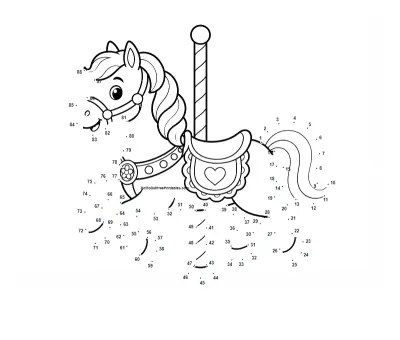
Connect 88 dots to reveal an elegant carousel horse ready for a magical ride. This detailed printable puzzle gives children an engaging way to practise number sequencing, concentration, and careful pencil control.
Difficulty
Hard
Fun fact: Traditional carousel horses often have a flowing mane and decorative saddle, and the horses that move up and down are called jumpers.
Downloaded7+timesYou’ve made a great choice!
Free for home and classroom use.
No sign-up needed. Opens as a PDF. Print on US Letter (8.5 × 11 inch) or A4 paper. Free for home and classroom use.
Playgrounds
You might also like
Ages 6–9 — Hard
How to Solve the Carousel Horse Playground Dot-to-Dot Puzzle
Carousel horses turn an ordinary ride into a galloping adventure. With a decorated saddle, flowing mane, and proud pose, each horse looks ready to leap from the platform and race away. This 88-dot puzzle offers a satisfying challenge for children who can confidently follow longer number sequences. Find dot 1, steady your pencil, and let the carousel begin to turn!
1–18 — The Horse's Head
Start at dot 1 and connect through dot 18 to shape the horse's face, muzzle, and alert ears. This section combines short angles with gentle curves, helping children slow down, look ahead, and guide the pencil carefully around detailed features.
Fun fact!
Carousel artists often give every horse a different expression. Some look calm and friendly, while others have raised heads and wide eyes to make them appear as though they are racing.
Carousel artists often give every horse a different expression. Some look calm and friendly, while others have raised heads and wide eyes to make them appear as though they are racing.
19–36 — The Flowing Mane and Neck
Continue from dot 19 to dot 36 to draw the curved neck and flowing mane. The changing direction of the mane gives useful practice with smooth, controlled curves while making the horse look as if it is moving through the wind.
Fun fact!
Many antique carousel horses were carved by hand from several pieces of wood. Skilled artists added deep grooves to the mane so it would catch the light and seem to ripple as the carousel turned.
Many antique carousel horses were carved by hand from several pieces of wood. Skilled artists added deep grooves to the mane so it would catch the light and seem to ripple as the carousel turned.
37–54 — The Saddle and Body
Trace dots 37 through 54 to build the horse's strong body and decorated saddle. Children move between longer body lines and smaller ornamental shapes, practising both steady strokes and close attention to detail.
Fun fact!
The most decorated side of a carousel horse usually faces outward where riders and spectators can see it. Carvers call this the romance side and often cover it with flowers, ribbons, jewels, or shields.
The most decorated side of a carousel horse usually faces outward where riders and spectators can see it. Carvers call this the romance side and often cover it with flowers, ribbons, jewels, or shields.
55–72 — The Galloping Legs
Connect dots 55 to 72 to draw the raised and stretching legs. These angled lines create the feeling of a frozen gallop. Encourage children to check each next number before drawing so the legs stay separate and easy to recognise.
Fun fact!
Carousel horses that move up and down are called jumpers, while horses fixed in place are sometimes called standers. The rising motion helps riders imagine that their horse is truly galloping.
Carousel horses that move up and down are called jumpers, while horses fixed in place are sometimes called standers. The rising motion helps riders imagine that their horse is truly galloping.
73–88 — The Tail and Finishing Details
Finish with dots 73 through 88 to add the sweeping tail and final decorative details. Sixteen careful connections complete the picture, rewarding children for maintaining concentration all the way through a longer puzzle.
Fun fact!
Carousels are also called merry-go-rounds. Early versions were inspired by horseback training games, but over time they became colourful amusement rides enjoyed by families around the world.
Carousels are also called merry-go-rounds. Early versions were inspired by horseback training games, but over time they became colourful amusement rides enjoyed by families around the world.
Wonderful work — your carousel horse is ready to ride! Colour the saddle with bright carnival shades, add ribbons or sparkling jewels, and design a carousel around it. For another playful challenge, explore more playground dot to dot printables.
Coloring Guide
Carousel Horse Playground: Classic Real-Life Colors
Traditional carousel horses were carved from wood and painted in lifelike coat colours with a gilded, jewelled saddle, and this palette follows that real craft.
- 1–18 (The Horse's Head): Crayola Scarlet — Carousel horse heads were carved from wood and painted in lifelike creams, greys or dappled browns, with glass eyes and a bright bridle.
- 19–36 (The Flowing Mane and Neck): Crayola Sky Blue — Carvers cut deep grooves into the wooden mane and often painted it a contrasting colour so it seemed to ripple as the ride turned.
- 37–54 (The Saddle and Body): Crayola Goldenrod — The body was usually a pale horse colour, while the outward-facing saddle was gilded and painted in bright carnival shades.
- 55–72 (The Galloping Legs): Crayola Scarlet — The legs were carved mid-stride and painted to match the body, with the hooves picked out darker for contrast.
- 73–88 (The Tail and Finishing Details): Crayola Sky Blue — The flowing tail was carved separately, painted like the mane, then finished with ribbons, jewels and gold trim.
Carousel Horse Playground: Soft Natural Colors
This lighter set shows an antique jumper whose paint and gold leaf have softened and faded after decades under fairground lights.
- 1–18 (The Horse's Head): Crayola Silver — Under fairground lights and sun, an antique horse's paint fades to soft, pale tones with the primer showing through at the edges.
- 19–36 (The Flowing Mane and Neck): Crayola Tan — Years of handling wear the mane's paint back to a pale, muted version, smooth where thousands of hands have gripped it.
- 37–54 (The Saddle and Body): Crayola Sea Green — Sunlight dulls the old gilding to a soft pewter shimmer and lightens the body to a gentle cream.
- 55–72 (The Galloping Legs): Crayola Silver — Bright daylight flattens the legs to a pale, chalky tone, especially along the raised edges that catch the most wear.
- 73–88 (The Tail and Finishing Details): Crayola Tan — The tail's colours fade first, sun-bleached to a soft pastel while the gold trim goes matte and pale.
Carousel Horse Playground: Bold Real-Life Colors
This bolder set imagines the horse freshly restored, repainted in glossy enamel with new gold leaf on the saddle and tail.
- 1–18 (The Horse's Head): Crayola Forest Green — A deeper shade recalls the rich, glossy enamel a restorer repaints a show horse in to make it gleam again.
- 19–36 (The Flowing Mane and Neck): Crayola Brown — A stronger colour matches the bold contrast carvers used on the mane so its carved grooves would read from across the platform.
- 37–54 (The Saddle and Body): Crayola Orange — A richer tone stands in for fresh gold leaf and jewel-bright lacquer on a fully restored romance side.
- 55–72 (The Galloping Legs): Crayola Forest Green — A bold finish suits the hard-wearing enamel over the legs, the part most scuffed by riders' shoes.
- 73–88 (The Tail and Finishing Details): Crayola Brown — A deep shade reflects the vivid lacquer and gilding a carver lavished on the tail as the horse's final flourish.
Why Is the Carousel Horse Playground Dot to Dot Printable Rated Hard?
The Carousel Horse Playground is rated hard. Its 88 dots are 26 straight, 33 curved, 12 zigzag and 17 sharp-turn dots. The stretches to slow down for are horse's head at dots 9–10 and galloping legs at dots 66–68. Follow the numbered order even when another dot looks nearer, and check the next number before each turn.
Straight
26 dots · 30%
Easiest — join two dots with one straight pencil stroke.
Curved
33 dots · 38%
27
Zigzag
12 dots · 14%
Quick in-and-out changes of direction. Good counting practice.
Sharp turns
17 dots · 19%
910
We traced all 88 dots on this exact worksheet by hand — the sharp turns at dots 9–10 is where it got tricky, and you can check that against your own printout.
Key Sections to Know
Every notable stretch of the path, dot by dot.
| Dot Range | Pattern | Why It Matters |
|---|---|---|
| 27 | Curved | A gentle curve shapes horse's head across dots 2–7. Spot dot 7 before you commit to the line. |
| 910 | Sharp turns | Dots 9–10 cut a sharp corner at horse's head; lift your eyes to dot 10 before drawing it. |
| 1114 | Curved | Around horse's head, the line eases through a smooth bend at dots 11–14; keep the pencil moving slowly. |
| 6668 | Curved | Dots 66–68 round off galloping legs — connect them one at a time so the arc stays even. |
| 7273 | Curved | The outline swings around galloping legs here; take dots 72 to 73 in short strokes. |
| 8485 | Curved | A gentle curve shapes tail and finishing details across dots 84–85. Spot dot 85 before you commit to the line. |
Bottom line: The Carousel Horse Playground dot to dot is hard rated — 67% smooth lines with just 1 short section to watch for.