Dinosaurs
Velociraptor Dot to Dot — Free 54-Dot Printable for Ages 5–7
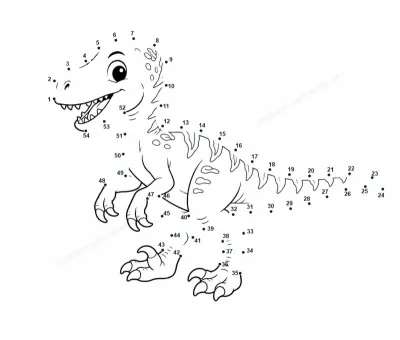
Connect the dots to reveal the clever Velociraptor — famous from Jurassic Park! In real life, Velociraptors were feathered hunters about the size of a turkey. This free dot to dot puzzle for kids builds number sequencing skills for ages 5–7.
Difficulty
Easy
Fun fact: "Velociraptor" means swift thief — one modelling study suggests it may have reached roughly 25 mph in short bursts!
Downloaded11+timesYou’ve made a great choice!
Downloads now start from the button below. Tap it to get this puzzle's PDF.
Free for home and classroom use.
No sign-up needed. Opens as a PDF. Print on US Letter (8.5 × 11 inch) or A4 paper. Free for home and classroom use.
Dinosaurs
You might also like
Ages 5–7 — Easy
How to Solve the Velociraptor Dot-to-Dot Puzzle
Everyone thinks they know what a Velociraptor looks like — but this puzzle might surprise them! The real Velociraptor was feathered, roughly the size of a large turkey, and clever for its size. Hollywood made it bigger, but nature gave it feathers. Grab a pencil and meet the real star of the Cretaceous!
1–8 — The Head and Jaws
Start at dot 1 and connect through to dot 8 to trace the long, narrow skull and slightly curved jaws. The Velociraptor had a particularly slender head compared to its body — children learn to follow a more elongated shape here, which is a useful shift from rounder dinosaur heads. Slow and steady wins this one.
Fun fact!
Velociraptor had around 80 small, serrated teeth designed for gripping rather than tearing. Studies of its brain cavity show it had excellent eyesight and a keen sense of smell — it hunted by sight, smell, and possibly hearing, making it a remarkably well-equipped little predator.
Velociraptor had around 80 small, serrated teeth designed for gripping rather than tearing. Studies of its brain cavity show it had excellent eyesight and a keen sense of smell — it hunted by sight, smell, and possibly hearing, making it a remarkably well-equipped little predator.
9–20 — The Neck and Feathered Body
Continue from dot 9 to dot 20 to build the curved neck and compact body. This is where children often start to see the bird-like quality of the Velociraptor, which makes for a wonderful classroom discussion. The dots curve smoothly — a good section for practising consistent pencil pressure.
Fun fact!
Palaeontologists have found quill knobs on Velociraptor arm bones — the same bumps you see on modern bird wings where feathers anchor in. Velociraptor was almost certainly covered in feathers, although it could not fly. It was a small feathered hunter, closely related to birds.
Palaeontologists have found quill knobs on Velociraptor arm bones — the same bumps you see on modern bird wings where feathers anchor in. Velociraptor was almost certainly covered in feathers, although it could not fly. It was a small feathered hunter, closely related to birds.
21–32 — The Arms and Hand Claws
Trace dots 21 through 32 for the relatively long arms and three-fingered hands. Unlike T-Rex's tiny arms, Velociraptor had arms it could actually use — for holding on and moving through its environment. Children practise sharper angles in this section, mimicking the angular, bird-wing shape of the forelimbs.
Fun fact!
Velociraptor's hand claws were strong and curved — very useful for gripping and holding on tight. Recent research suggests it may have used its arms similarly to how hawks and eagles perch on branches today, pressing down with its body weight.
Velociraptor's hand claws were strong and curved — very useful for gripping and holding on tight. Recent research suggests it may have used its arms similarly to how hawks and eagles perch on branches today, pressing down with its body weight.
33–44 — The Legs and Special Claw
Connect dots 33 to 44 to draw the powerful hind legs and that famous sickle-shaped claw on the second toe. Children often recognise this claw from films, which makes it a motivating section. The dots are close together here, encouraging precision and careful number recognition.
Fun fact!
The iconic curved claw on each foot was held off the ground when Velociraptor walked to keep it nice and sharp — a bit like a cat keeping its claws tidy! Scientists now think it was used mainly for gripping and holding on rather than anything else.
The iconic curved claw on each foot was held off the ground when Velociraptor walked to keep it nice and sharp — a bit like a cat keeping its claws tidy! Scientists now think it was used mainly for gripping and holding on rather than anything else.
45–54 — The Stiff Tail
Finish by connecting dots 45 through 54 to add the long, stiffened tail. Unlike the flexible tails of lizards, the Velociraptor tail was held straight out behind it, acting as a counterbalance when running and turning at speed. A confident, straight finish to a dynamic puzzle.
Fun fact!
Velociraptor may have reached speeds of around 25 miles per hour in short bursts — fast for a small predator, though slower than the Jurassic Park version. Its tail stiffened naturally through ossified tendons, letting it make sharp turns without toppling over, almost like a built-in stabiliser.
Velociraptor may have reached speeds of around 25 miles per hour in short bursts — fast for a small predator, though slower than the Jurassic Park version. Its tail stiffened naturally through ossified tendons, letting it make sharp turns without toppling over, almost like a built-in stabiliser.
Fantastic work! You have drawn one of the most misunderstood dinosaurs in history. Why not look up what Velociraptor actually looked like compared to the film version — it is a brilliant lesson that real life is often more interesting than fiction! Meet more prehistoric friends in our dinosaur dot to dot printable collection.
Coloring Guide
Velociraptor: Classic Real-Life Colors
Because the real Velociraptor was a feathered, turkey-sized hunter, illustrators usually give it the streaky browns and greens of a ground bird like a roadrunner or a hawk.
- 1–8 (The Head and Jaws): Crayola Olive Green — Olive green on the long narrow skull suits a hunter that found prey by sight and smell, its jaws lined with about eighty small serrated teeth for gripping.
- 9–20 (The Neck and Feathered Body): Crayola Forest Green — Forest green over the neck and compact body stands in for the feather coat we know it had from quill knobs on its arm bones.
- 21–32 (The Arms and Hand Claws): Crayola Brown — Brown on the long arms and curved hand claws matches a wing-like limb it may have used to pin prey under its own weight.
- 33–44 (The Legs and Special Claw): Crayola Olive Green — Olive green on the running legs sets off the sickle claw on the second toe, held up off the ground to stay sharp.
- 45–54 (The Stiff Tail): Crayola Forest Green — Forest green along the stiff tail, locked straight by bony tendons, shows the counterweight that let it turn at speed.
Velociraptor: Soft Natural Colors
A small feathered predator slipping through sunlit scrub would look pale and dusty, its plumage bleached like a desert lark's in the Gobi heat.
- 1–8 (The Head and Jaws): Crayola Gray — Pale grey shows the slim skull in bright light, the many little teeth barely catching a shadow.
- 9–20 (The Neck and Feathered Body): Crayola Silver — Silver-grey over the neck and body is how sun-faded feathers read at midday.
- 21–32 (The Arms and Hand Claws): Crayola Tan — Warm tan on the arms and hand claws suggests lighter feathering down the wing-like forelimb.
- 33–44 (The Legs and Special Claw): Crayola Gray — Grey on the legs keeps them dusty and plain so the raised killing claw still stands out.
- 45–54 (The Stiff Tail): Crayola Silver — Silver-grey along the stiff tail fades the long counterbalance almost into the page.
Velociraptor: Bold Real-Life Colors
Living birds of prey often wear rich rufous and chestnut, so some artists give Velociraptor bold warm feathers with barred or spotted markings.
- 1–8 (The Head and Jaws): Crayola Raw Sienna — Raw sienna warms the narrow head, the kind of bright face pattern many hunting birds use.
- 9–20 (The Neck and Feathered Body): Crayola Mahogany — Deep mahogany over the feathered body reads as the rich chestnut of a hawk's back.
- 21–32 (The Arms and Hand Claws): Crayola Goldenrod — Goldenrod on the arms lights up the wing-like forelimbs an artist might mark with bold bars.
- 33–44 (The Legs and Special Claw): Crayola Raw Sienna — Raw sienna on the legs makes the powerful drumstick and its sickle claw the strongest colour here.
- 45–54 (The Stiff Tail): Crayola Mahogany — Mahogany along the stiff tail turns the running counterweight into a bold banner.
Why Is the Velociraptor Dot to Dot Printable Rated Easy?
The Velociraptor is rated easy. Of its 54 dots, 31 run in straight lines, with 6 curved, 7 zigzag and 10 sharp-turn dots. The stretches to slow down for are legs and special claw at dots 35–36 and head and jaws at dots 7–9. Follow the numbered order even when another dot looks nearer, and check the next number before each turn.
Straight
31 dots · 57%
Easiest — join two dots with one straight pencil stroke.
Curved
6 dots · 11%
7 9
Zigzag
7 dots · 13%
Quick in-and-out changes of direction. Good counting practice.
Sharp turns
10 dots · 19%
35 36
We traced all 54 dots on this exact worksheet by hand — the sharp turns at dots 35–36 is where it got tricky, and you can check that against your own printout.
Key Sections to Know
Every notable stretch of the path, dot by dot.
| Dot Range | Pattern | Why It Matters |
|---|---|---|
| 7 9 | Curved | Follow head and jaws as it curls from dot 7 to dot 9, easing the line rather than snapping it. |
| 35 36 | Sharp turns | There is a tight angle at legs and special claw here; treat dots 35 and 36 as two separate short lines. |
Bottom line: The Velociraptor dot to dot is easy rated — 69% smooth lines with just 1 short section to watch for.