Canada
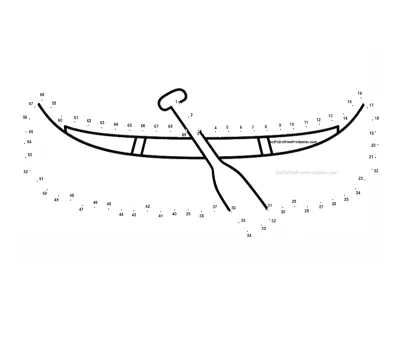
Canadian Canoe Dot to Dot — Free 69-Dot Printable for Ages 5–9
Connect 69 dots to reveal a Canadian canoe and paddle. This medium printable builds number sequencing and pencil control while introducing a watercraft closely connected with travel in Canada.
Difficulty
Medium
Fun fact: Canoes made it possible to carry people and supplies along interconnected lakes and rivers where roads did not exist.
Downloaded10+timesYou’ve made a great choice!
Free for home and classroom use.
No sign-up needed. Opens as a PDF. Print on US Letter (8.5 × 11 inch) or A4 paper. Free for home and classroom use.
Canada
You might also like
— Medium
How to Solve the Canadian Canoe Dot-to-Dot Puzzle
The canoe is one of the most recognisable watercraft in Canada. Indigenous Peoples developed sophisticated canoe designs suited to local waters and available materials, and later travellers relied on canoes to move through vast networks of rivers and lakes. This 69-dot puzzle traces the paddle and the canoe's long, graceful hull. Find dot 1 and begin your journey!
1–14 — The Paddle and Upper Rim
Begin at dot 1 and connect through dot 14 to outline the paddle and the canoe's upper edge. Follow the long line steadily and check each number before the bow curves upward.
Fun fact!
A paddle has a handle, shaft, and blade. The broad blade pushes against the water to move and steer the canoe.
A paddle has a handle, shaft, and blade. The broad blade pushes against the water to move and steer the canoe.
15–28 — The Rising Bow
Continue from dot 15 to dot 28 around the high front of the canoe. Slow down as the outline changes direction so the pointed bow stays smooth.
Fun fact!
The bow is the front of a canoe and the stern is the back. Their raised shapes help the boat travel through waves and moving water.
The bow is the front of a canoe and the stern is the back. Their raised shapes help the boat travel through waves and moving water.
29–42 — The Paddle Blade and Hull
Trace dots 29 through 42 around the paddle blade and lower hull. Use controlled curves where the two shapes pass close together.
Fun fact!
The Geological Survey of Canada relied on canoes during early northern fieldwork. See its historic 1874 canoe on the Government of Canada website.
The Geological Survey of Canada relied on canoes during early northern fieldwork. See its historic 1874 canoe on the Government of Canada website.
43–56 — The Long Lower Side
Connect dots 43 to 56 along the sweeping underside. These longer gaps reward a steady hand and careful visual tracking.
Fun fact!
Traditional canoes were built in different forms across Indigenous cultures, using materials such as birchbark, cedar, animal hides, and carefully shaped wood.
Traditional canoes were built in different forms across Indigenous cultures, using materials such as birchbark, cedar, animal hides, and carefully shaped wood.
57–69 — The Stern and Finish
Finish with dots 57 through 69 around the stern and back to the upper edge. Count carefully to the final dot and check that the entire hull is connected.
Fun fact!
Paddling conditions can change quickly, so preparation and proper safety equipment matter. Families can learn about canoeing and water safety from Parks Canada.
Paddling conditions can change quickly, so preparation and proper safety equipment matter. Families can learn about canoeing and water safety from Parks Canada.
Excellent—your canoe is ready for the water! Colour the hull, add ripples below it, and draw a Canadian lake or forest in the background. Explore more official paddling ideas from Parks Canada, then try another Canada dot to dot puzzle.
Coloring Guide
Canadian Canoe: Classic Real-Life Colors
Real lake canoes mix painted trim with the natural colour of cedar, birchbark, and hardwood, and this palette keeps each part close to what you would see on the water.
- 1–14 (The Paddle and Upper Rim): Crayola Scarlet — Many wooden canoes are finished with a bright painted rim, and a red gunwale and matching paddle are a classic look on Canadian lake canoes.
- 15–28 (The Rising Bow): Crayola Sky Blue — The tall bow spends the whole trip cutting through open water, so it easily picks up the blue of the lake and sky around it.
- 29–42 (The Paddle Blade and Hull): Crayola Goldenrod — Cedar and carefully shaped wood give a bare paddle blade and hull a warm honey-gold tone before any paint is added.
- 43–56 (The Long Lower Side): Crayola Scarlet — A painted hull is usually one solid colour from bow to stern, so the long lower side carries the same red as the rim.
- 57–69 (The Stern and Finish): Crayola Sky Blue — The stern sits low where the paddler steers, trailing through the water and reflecting the same lake blue as the bow.
Canadian Canoe: Soft Natural Colors
Sun, spray, and years of weather bleach a working canoe, and these paler tones show a well-used boat drawn up on a bright shoreline.
- 1–14 (The Paddle and Upper Rim): Crayola Silver — Under bright midday sun the wet, varnished rim loses its colour and reads as a pale silvery grey.
- 15–28 (The Rising Bow): Crayola Tan — Sun-bleached birchbark on an older canoe fades to a soft tan, most visibly on the high bow that catches the most light.
- 29–42 (The Paddle Blade and Hull): Crayola Sea Green — In shallow sunlit water the hull takes on a pale green cast from light bouncing off the sandy lake bottom.
- 43–56 (The Long Lower Side): Crayola Silver — The long side that faces the sky dries lightest, turning a washed-out silver-grey in full daylight.
- 57–69 (The Stern and Finish): Crayola Tan — Dry, weathered wood at the stern pales to light tan where the afternoon sun sits on it for hours.
Canadian Canoe: Bold Real-Life Colors
Factory canoes come in deep greens and browns and oiled wood glows orange, so this set leans into those richer painted-and-varnished colours.
- 1–14 (The Paddle and Upper Rim): Crayola Forest Green — Deep forest green is one of the most common factory paint colours for canvas-covered canoes, carried along the rim and the paddle.
- 15–28 (The Rising Bow): Crayola Brown — Birchbark stitched with spruce root and sealed with pitch makes a traditional bow a deep reddish brown.
- 29–42 (The Paddle Blade and Hull): Crayola Orange — Oiled cedar strips glow a rich burnt orange, strongest across the broad paddle blade and the hull planking.
- 43–56 (The Long Lower Side): Crayola Forest Green — The full length of a painted hull carries the same deep green, so the lower side stays bold from end to end.
- 57–69 (The Stern and Finish): Crayola Brown — The hardwood shaped for the stem and stern pieces is the darkest wood on the boat, a strong chocolate brown.