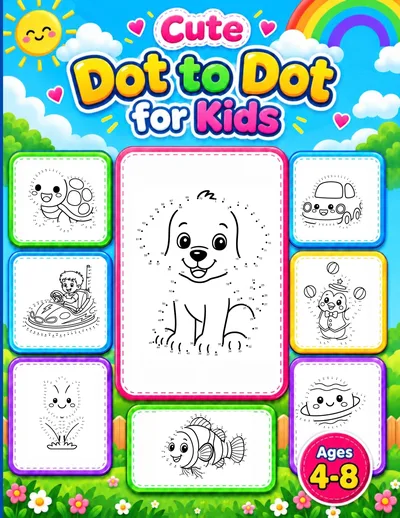

12 puzzles
Roman Numerals Dot to Dot Printables
Free Roman numerals dot to dot PDFs with 43–50 dots. Follow I to the final numeral, check IV, IX and XL, and print in A4 or US Letter.
Browse all 12 roman numerals dot to dot puzzles
Space
Flowers
Halloween
America 250 Years

Roman Numerals
America 250 Space Shuttle
Launch into America's 250th with the Space Shuttle!
View & Download
Cute
Ocean
Playgrounds
Roman Numerals dot to dot: a guide for parents and teachers
Roman Numerals Dot to Dot: Count I, II, III to a Finished Picture
Roman numerals dot to dot printables replace ordinary numbers with Roman numerals. A child starts at I, draws to II, then III, IV and V, and keeps counting until an animal, flower or space picture appears, ready to colour.
The guidance here is in English for parents and teachers. Roman numerals are a common topic in primary maths, and they turn up in daily life too: clock faces, book chapters, film credits and the names of monarchs and events. A picture puzzle gives a reason to read them in order.
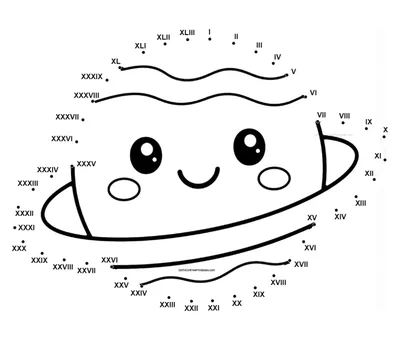
Choose a picture in the grid and open its Roman Numerals Version. The drawing and dot order are identical to the ordinary numbered puzzle; only the labels are written differently.
How the Labels Are Written: I, V, X and L
Every label in this collection is built from four symbols: I (1), V (5), X (10) and L (50). Symbols are added when a smaller one follows a larger one, so VI is 6 and XII is 12.
When a smaller symbol comes before a larger one, it is subtracted. That gives IV for 4, IX for 9 and XL for 40, the standard modern forms. After III, the next dot is IV, not IIII, and after VIII, the next is IX. These are useful steps to check before beginning, and the puzzle presents them in context.
There is no zero in Roman numerals, and none is needed here because the trail starts at I. Every picture in this collection has between 43 and 50 dots, so the highest label is L. The sequence never restarts.
Where the Tricky Numerals Fall on the Trail
Watch for IV (4), IX (9), XIV (14), XIX (19), XXIV (24), XXIX (29), XXXIV (34), XXXIX (39) and the jump to XL (40). Each of these uses subtraction, and each is easy to misread at a glance.
The forties introduce a new pattern: XL, XLI, XLII, XLIII and onward. Every picture in this collection reaches the forties, so it is worth writing XL and its neighbours on a strip before starting.
Some clock faces show 4 as IIII instead of IV. That is a long-standing clockmaking tradition; the worksheets use the standard IV form found in schoolbooks.
Choosing a Picture
The collection currently holds 12 pictures with between 43 and 50 dots. Each card shows the suggested age range and difficulty, calculated from a geometric analysis of the original puzzle rather than guessed.
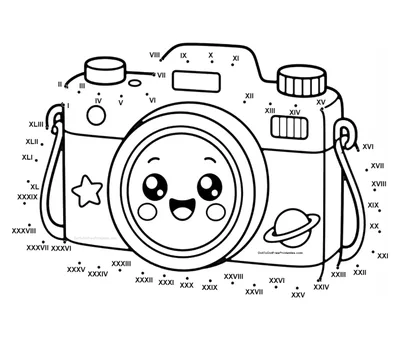
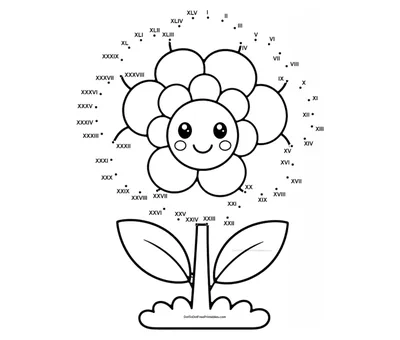
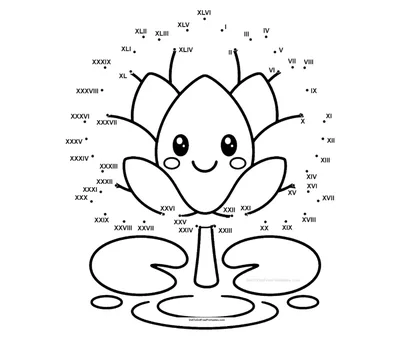
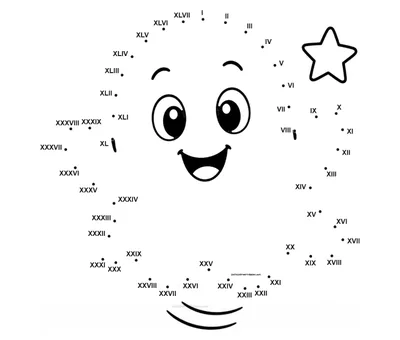
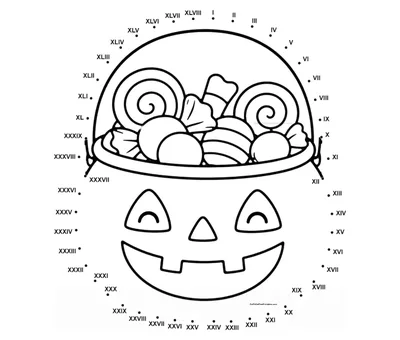
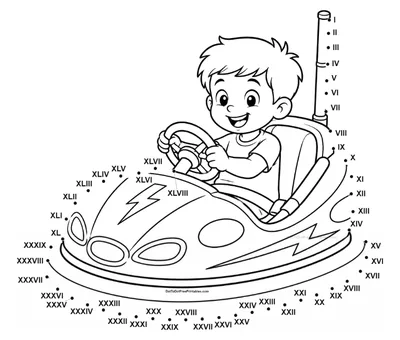
The shortest options, at 43 dots, are Ringed Planet (43 dots, ends at XLIII), Saturn (43 dots, ends at XLIII), Space Camera (43 dots, ends at XLIII). In the middle are Camellia Flower (45 dots, ends at XLV), Lotus Flower (46 dots, ends at XLVI), Friendly Ghost (47 dots, ends at XLVII), Dashing Car Playground (48 dots, ends at XLVIII), Trick-or-Treat Candy Bucket (48 dots, ends at XLVIII).
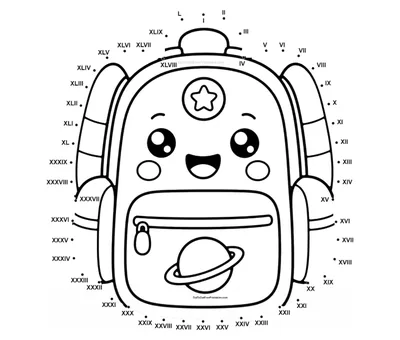
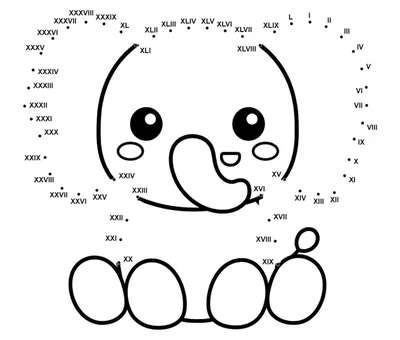
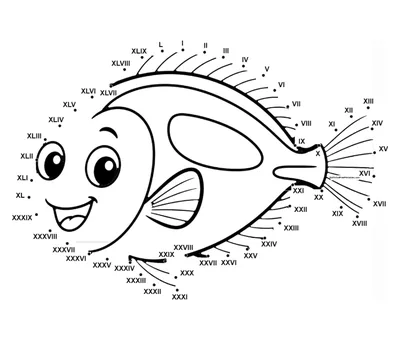
The longest, at 50 dots, end on L itself: America 250 Space Shuttle (50 dots, ends at L), Astronaut Backpack (50 dots, ends at L), Blue Tang (50 dots, ends at L), Cute Baby Elephant (50 dots, ends at L). Finishing at L gives a satisfying ending, because the final dot is a single new symbol.
How to Start a Roman Numeral Connect the Dots Activity
Write a reference strip from I to L, or just the tricky ones, before handing over the pencil. Join I to V together and talk about why the fourth dot says IV.
At each multiple of ten, X, XX, XXX and XL, pause and ask what comes next. Breaking the trail into tens matches how Roman numerals are built.
Use a pencil while learning. If a line looks wrong, go back to the last certain dot. The ordinary numbered version of the same puzzle has identical dot positions, so it is a quick way to check.
Small Games That Build Roman Numeral Confidence
Play “translate the dot”: point to a random label on the sheet and ask what ordinary number it is. Then find the dot before and after it.
Use a clock. Many clocks show Roman numerals, and children can match the numbers on the clock face to the first twelve dots, noticing whether that clock shows IV or IIII.
Make a subtraction hunt: find every label on the sheet with a smaller numeral before a larger one, such as IV, IX or XL, and tick it lightly in pencil.
Try a reverse challenge for older children: write the ordinary numbers 1 to 10 and ask them to write the Roman forms before the puzzle, then check against the sheet.
After finishing, write the child’s age in Roman numerals under the picture. Larger numbers, such as years, use symbols like C, D and M, which are not on these sheets.
At Home or in a Maths Lesson
At home, a sheet can fit into a quiet ten minutes, and the picture gives a natural stopping point. Children who already count confidently to 50 bring that knowledge with them.
In a classroom, the sheets work as a station activity alongside a Roman numerals lesson. Pairs can alternate between reading and drawing, and an adult can check the forties.
Choose one focus per sheet, such as subtraction forms or counting by tens, and keep the reference strip available for everything else.
Common Mix-Ups and How to Fix Them
The most frequent mistake is reading IV as 6 or VI as 4. The order of the symbols matters: a smaller symbol before a larger one subtracts, after it adds. Write IV and VI side by side and talk through each before starting.
A second slip is skipping a dot because two labels look alike at a glance, such as XXVIII and XXIII, or XXXIX and XXIX. Encourage your child to read the whole label, symbol by symbol, before drawing.
Losing the place is the third. Longer numerals in the thirties and forties take more effort to read, so a light pencil tick by the last joined dot helps. Stopping halfway and finishing later is perfectly fine.
Why Roman Numerals Are Still Worth Learning
Roman numerals were the number system of ancient Rome and remained in common use in Europe for many centuries. Today they are mostly decorative or traditional, but children still meet them on clocks, in book chapters, on buildings and in the names of kings, queens and sporting events.
Reading them involves a different kind of thinking from ordinary place-value numbers. Each symbol has a fixed value wherever it appears, and its position next to other symbols decides whether it is added or subtracted. Working through 1 to 50 in order shows that pattern again and again.
A dot-to-dot cannot teach all of that, but it gives plenty of repetition in a form children enjoy. The picture provides the reward, and the reference strip provides the support.
From Numbers to Numerals: a Gentle Progression
For a child who is new to Roman numerals, start with the ordinary numbered version of the same puzzle. Once they have finished it, print the Roman Numerals Version and compare the two sheets side by side.
Point out that the dots are in exactly the same places: dot 4 on one sheet is dot IV on the other. That makes the Roman labels feel like another way of writing numbers the child already knows.
After a few pictures, children often stop needing the reference strip for I to XX. Keep it nearby for the thirties and forties until those feel familiar too.
Reading a Numeral Symbol by Symbol
A reliable way to read any label on these sheets is to split it into tens and ones. XXXVII is XXX (30) followed by VII (7), so it is 37. XLVI is XL (40) followed by VI (6), so it is 46. Saying the two parts aloud keeps longer labels from blurring together.
Each part follows a short pattern. The ones run I, II, III, IV, V, VI, VII, VIII, IX, and the tens run X, XX, XXX, XL, L. Once a child knows those two lists, every label from I to L is a tens part followed by a ones part.
Write the two lists on a card and keep it beside the picture. When a label looks confusing, cover the tens part with a finger, read the ones part, then uncover and combine them. This works for every dot in the collection.
Mixing Roman Numerals With Ordinary Numbers
Some children like to write the ordinary number lightly beside a few labels as they go, for example 4 beside IV and 9 beside IX. Doing this only for the subtraction forms keeps the page tidy and puts the help where it is most needed.
Another option is to complete the first ten dots with a reference strip, then hide the strip for the next ten and see how far the child can go alone. Bring the strip back as soon as it is needed; the aim is confidence, not a test.
If two children work together, one can read each label aloud as an ordinary number while the other finds and joins the dot. Swapping roles every ten dots gives both of them practice in reading and in searching.
What These Worksheets Practise, and What They Do Not
The sheets practise reading Roman numerals from I to L in order, recognising subtraction forms and keeping track of a sequence. Joining the dots also gives practice in controlled pencil lines.
They do not cover C, D or M, larger numbers or formal conversion exercises. Use a maths worksheet or textbook for those once the first fifty feel easy.
They are not handwriting pages either. If you want children to write the numerals, add that on separate paper.
Printing a Clear Roman Numerals PDF
Open the puzzle, choose Roman Numerals Version and download the PDF in A4 or US Letter. Printing the PDF keeps labels sharper than printing a screenshot.
Print at actual size (100%). Longer labels such as XXXVIII take more space than ordinary numbers, so check one sample before making copies to make sure every label is readable.
Use a sharp pencil for the trail and leave heavy colouring until the end.
Check the print preview before making copies. If an edge is clipped, use the printer’s fit option or reduce the scale only enough to keep the whole drawing on one page. Check the smallest labels again after resizing.
Build a Roman Numeral Repair Shop
Before drawing, make three cards showing III, IV and V. Put them in order and explain why IV belongs between its neighbours. Repeat with VIII, IX and X if helpful. The child can use ordinary numbers underneath as a check; there is no need to hide a useful reference.
Now invite the learner to run a repair shop: an adult deliberately puts one card in the wrong place, and the learner explains how to fix the order. Keep the intentional mistake on scrap paper, not on the worksheet. Return to the trail and read the complete numeral before connecting. At the finish, compare XLIX with L to see how the label can become shorter while the value increases. This gives the symbol rules a concrete purpose without making speed the goal.
About This Guide and Reporting a Problem
The Roman numerals version keeps the picture, dot positions and order of the original puzzle and only changes the labels. The final numerals on this page were calculated from the listed dot counts.
This guide was prepared with AI-assisted drafting and editing. Puzzle examples and numerals were checked against the site’s puzzle data; it has not been reviewed by a specialist teacher. Read about the project on our About page and see our editorial policy.
If a label or download looks wrong, report the problem with the puzzle URL and the version name, Roman Numerals Version. See our terms of use for printing permissions. For letters instead of numerals, try the English alphabet dot to dot printables.
The activity ideas are suggestions for home and classroom use, not results from a classroom trial or a promise of reading progress.
FAQ
Roman Numerals worksheet FAQs
Are these Roman numerals dot to dot printables free?
Yes. Every Roman Numerals Version is a free PDF in A4 and US Letter for home and classroom use, with no sign-up. Please do not resell or republish the files.
Which numerals appear on the worksheets?
The labels count from I up to the picture’s dot count, using I, V, X and L. The highest is L (50), so C, D and M do not appear.
Do the sheets use IV or IIII for 4?
They use IV, the standard subtractive form, along with IX for 9 and XL for 40. IIII appears on some clock faces but is not used here.
Does the sequence restart?
No. Every picture has 50 dots or fewer, so the numerals count straight through and the last dot shows the dot count.
What ages are these worksheets for?
Each card shows a suggested age range and difficulty. Reading Roman numerals is usually taught later than basic counting, so younger children may need an adult and a reference strip.
How do I check a confusing section?
Open the ordinary numbered version of the same puzzle. It uses identical dot positions, so the number tells you which dot comes next.
Do these worksheets teach conversion and larger numbers?
Only up to L (50). For larger numbers and conversion practice, add a maths worksheet after the puzzle.
Can a beginner use these without knowing every numeral?
Yes, with a reference digit strip and help for a short section. Choose a picture the learner likes, then pause or finish together. The card’s suggested age describes the drawing challenge, not mastery of Roman numerals. Completing a picture is not a reading assessment.
Why can the next Roman numeral be shorter than the previous one?
The number of letters does not determine the value. IX is 9 and X is 10; XLIX is 49 and L is 50. Read the complete numeral before choosing the next point. If the symbol change is confusing, compare the same position on the ordinary numbered version of the picture.